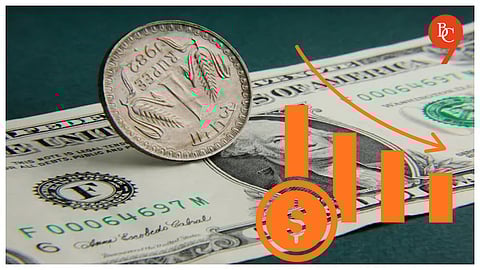


Yesterday the Indian Rupee record a historic low of ₹90.17 against the US dollar, marking its deepest depreciation since independence. The fall comes at a time when global markets are volatile and investor confidence in emerging economies is shifting.
Currency specialists say the rupee’s decline does not signal weak fundamentals but reflects policy uncertainty and global pressures. The delay in the India-US trade agreement and rising US tariffs have unsettled markets. Foreign investors have withdrawn nearly $17 billion from Indian equities in 2025, further weakening the currency.
Adding to this, the RBI has taken a more hands-off approach. The IMF recently reclassified India’s exchange rate regime, indicating that the central bank is guiding rather than tightly defending the rupee. This shift has allowed the market to push the currency lower.
The impact of the rupee’s fall is now reaching Indian households. Since India imports most of its crude oil and relies heavily on foreign goods like electronics, fertilizers, edible oils, and machinery, a weaker rupee raises the cost of these items. This leads to higher fuel prices, costlier consumer goods, and increased inflation.
For students studying abroad, expenses have risen sharply. Tuition fees, rent, and daily costs paid in dollars or other foreign currencies now demand significantly more rupees, with many spending ₹5–10 lakh more a year compared to two years ago.
A currency’s value is shaped by a country’s economic conditions and the exchange rate system it follows. Most countries, including India, operate under a floating or managed-float system, where the market largely decides the exchange rate.
Supply and demand, interest rates, inflation levels, trade performance, and overall investor confidence all influence how a currency moves.
Some nations follow a fixed exchange rate, where the government pegs its currency to another, actively intervening to maintain stability. India, however, allows its exchange rate to adjust with market forces, with the RBI stepping in only when fluctuations become too sharp.
India’s exchange rate has changed dramatically over the decades. In 1947, one dollar equalled ₹1. By 1949, it had moved to ₹4.76, and by 1966 to ₹7.50. The rupee continued to weaken as the economy expanded and global dynamics shifted, reaching ₹44.31 in 2000, ₹54.78 in 2013, ₹74.31 in 2020, and ₹83.28 in 2024. The latest drop to ₹90.17 in December 2025 marks its steepest point yet.
