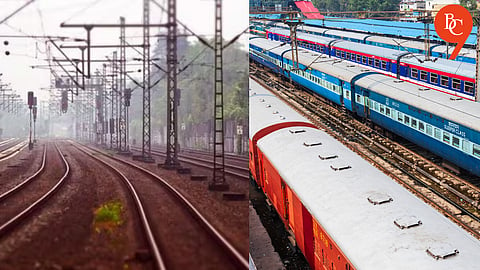


Rail stocks: On Friday, December 26, stocks of rail-associated firms like IRCTC, RVNL, and Ircon International, among others, experienced significant increases in morning trading as the government's newly announced fares took effect today.
Recently, shares of Rail Vikas Nigam (RVNL) surged by up to 11.77%, reaching a peak of ₹386.40 each on the NSE. Meanwhile, IRCTC shares increased by 2.75% to ₹698.35. Ircon International's stock rose by more than 8% to ₹184.72, and RITES was trading approximately 5% higher at ₹254.44.
Shares of Titagarh Rail Systems increased by more than 5% to ₹900.50, while BEML saw a rise of 2.4% to ₹1,913.50. Jupiter Wagons was trading at ₹352.15, marking a 3.39% increase on the NSE. This marks the second instance within a year that the ministry has adjusted passenger train fares, with the previous increase occurring in July.
The ministry explained its decision by stating that the aim of adjusting fares is to achieve a balance between making travel affordable for passengers and ensuring the sustainability of operations.
Here is the information you should be aware of
“According to the updated fare structure, there will be no fare adjustments for suburban services and season tickets, covering both suburban and non-suburban routes. However, for ordinary non-AC (non-suburban) services, fares have been adjusted in a tiered approach for second class ordinary, sleeper class ordinary, and first class ordinary, as stated by the ministry.
It stated, "In second class ordinary, fares remain unchanged for trips up to 215 km, protecting short-distance and daily travelers from any fare hikes. For distances ranging from 216 km to 750 km, there is a ₹5 increase. For longer trips, the fare rise is incremental -- ₹10 for distances between 751 km and 1250 km, ₹15 for distances between 1251 km and 1750 km, and ₹20 for distances between 1751 km and 2250 km."
The ministry has announced a uniform revision in fares for sleeper class ordinary and first class ordinary, increasing by 1 paise per kilometre for non-suburban trips, to ensure a gradual and modest rise in ticket prices.
The statement mentioned that for mail and express trains, the fare adjustment has been standardized to an increase of 2 paise per kilometer for both non-AC and AC classes.
"This encompasses sleeper class, first class, AC chair car, AC 3-tier, AC 2-tier, and AC first class. For example, for a 500 km trip in non-AC mail/express coaches, travelers will incur an additional cost of approximately Rs 10, according to the statement.
In which situations is this relevant?
The official announcement indicated that the existing base fares for major train services, including Tejas Rajdhani, Rajdhani, Shatabdi, Duronto, Vande Bharat, Humsafar, Amrit Bharat, Tejas, Mahamana, Gatimaan, Antyodaya, Garib Rath, Jan Shatabdi, Yuva Express, Namo Bharat Rapid Rail, and standard non-suburban services (excluding AC MEMU/DEMU, where applicable), have been revised in line with the approved class-specific basic fare increases.
The updated fares will apply solely to tickets purchased on or after December 26, 2025. Tickets bought before this date will not incur extra charges, even if the travel occurs after the new fares take effect," it stated. The fare lists shown at stations will also be revised to show the new fares starting December 26. As per the Railway Ministry, the last fare increase in July 2025 has so far generated ₹700 crore in revenue.
Attention on railway shares
Railway stocks have been active since the government declared an increase in train fares. Additionally, these stocks are drawing attention due to anticipated budget allocations for the sector in the forthcoming Union Budget for 2026-27 (FY27).
As reported by the business daily Mint, the Union budget for the fiscal year 2027 might allocate an unprecedented ₹1.3 trillion for rail safety, which constitutes almost half of the Indian Railways' capital spending, in response to ongoing worries about accidents and the sluggish implementation of safety systems.
With inputs from PTI
