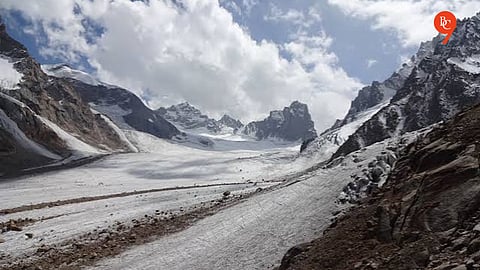

The eastern Himalayan state of Sikkim has pinpointed 40 glacial lakes as high-hazard, with 16 deemed at the greatest risk of catastrophic outbursts that could endanger communities located downstream..
The data is significant as it comes against the backdrop of the recent flash flood in Nepal, triggered by a glacial collapse near the Nepal-Tibet border on August 26 that left a trail of destruction with hundreds of people dead and scores missing.
Though the catastrophe was not linked to a Glacial Lake Outburst Flood (GLOF), the flash flood has highlighted a broader transformation across the Himalayas as glaciers retreat, new lakes are forming in their place, while existing ones are expanding.
Glacial lakes develop when glaciers melt and the resulting water collects in depressions on or near the glacier’s surface. Glacial lake outburst floods (GLOFs) occur when these lakes suddenly release their water, often due to excessive buildup or external triggers such as earthquakes.
These events can cause severe destruction and pose major threats to communities and ecosystems downstream.
In October 2023, one such outburst in Sikkim led to at least 60 deaths and widespread damage across the Mangan, Gangtok, Pakyong, and Namchi districts. The flood also destroyed the Chungthang dam, a key component of a large hydropower project.
During a media sensitisation workshop on GLOF risk mitigation held in Gangtok on Thursday, principal secretary Sandeep Tambe stated that remote sensing and satellite imagery are being employed to track changes in glacial lakes.
Of the 40 lakes classified as high-hazard, 16 fall into Category A (highest risk), two into Category B (high risk), and nine into Category C (moderate to low risk), while 13 have not yet been assigned a category, he said.
The workshop focused on strengthening public understanding of GLOF risks and ensuring that verified, science-based information reaches the public.
Yougan Tamang, press secretary to Chief Minister Prem Singh Tamang, said that sensitising the media is vital for conveying the scientific steps being taken to reduce GLOF risks.
He added that in February 2025, Sikkim’s Department of Science and Technology was appointed as the nodal agency for GLOF hazard assessment and mitigation research, which is being conducted through an interdisciplinary framework.
The state is also developing what may become the country’s first dedicated GLOF Risk Mitigation Protocol, designed to establish a standardized scientific framework for evaluating, preparing for, and reducing glacial flood risks.
According to an official release, it could additionally serve as a template for other Himalayan regions.
Field investigations encompass monitoring water levels and discharge, conducting Electrical Resistivity Tomography, performing geophysical and differential global positioning system surveys, carrying out bathymetric measurements, developing flood models, evaluating hazards, and undertaking feasibility studies aimed at reducing lake levels and building flood-retention structures.
Tambe stated that a single, uniform approach could not be used for all the lakes, so individual plans were drawn up for the Lhonak Complex, Shako Chho Lake and Gurudongmar Complex, the release said.
The Sikkim government has identified Shako Chho as most vulnerable to GLOF.
The Detailed Project Report (DPR) for Shako Chho has been submitted to the National Disaster Management Authority, while an initial project report has been forwarded to the Jal Shakti Ministry.
The Central Water Commission, in collaboration with the Sikkim government, is drafting a DPR for a flood-retention structure at Dolma Sampa near Muguthang in the Lhonak Complex.
For the Gurudongmar Complex, a moraine plug wall has been proposed at the lake’s outlet. The Department of Science and Technology and the Brahmaputra Board are collaborating on this proposal, considering both the risk of glacial lake outburst floods (GLOFs) and the lake’s cultural and religious importance.
The principal director-cum-secretary of the science and technology department, D G Shrestha, said that Sikkim’s catastrophic 2023 GLOF highlighted the urgent need to bolster preparedness.
At the policy level, the state is adopting a whole-of-government strategy, refining business rules, implementing steps to address gaps in technical expertise, and advancing a proposal to establish a commission on glacial hazards.
Multiple methods for reducing lake levels are being explored, such as siphoning, pumping, enhancing current channels, constructing artificial channels, cutting through moraines with protective walls, and tunnelling.
Shrestha described a four-phase mitigation approach—preliminary assessment, detailed assessment, design of mitigation measures, and implementation—and emphasized the importance of bolstering institutional, technical, and financial capacities.
He added that more early-warning sensors have been proposed for installation across Sikkim after a virtual meeting with Union Home Secretary Govind Mohan, who gave a favourable assurance regarding the plan.
On Thursday, Union Home Secretary Govind Mohan assessed how well the Himalayan states and Union territories are prepared to handle GLOF threats and snow avalanches.
The meeting was attended by the chief secretaries and State Disaster Management Authorities of Uttarakhand, Himachal Pradesh, Sikkim, Arunachal Pradesh, and Jammu and Kashmir, together with senior officials from the Ministry of Home Affairs, the National Disaster Management Authority, the Central Water Commission, the India Meteorological Department, and the Defence Geoinformatics Research Establishment.

