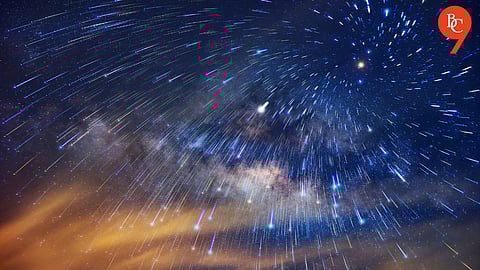


Get ready, the night sky is going to put on one of its oldest recorded spectacles as the Lyrid meteor shower returns, sending streaks of light across Earth in a dazzling annual display. The Lyrid meteor shower was first documented in 687 B.C. and is now active through April 30, 2026.
Join our WhatsApp Channel to Stay Updated!
Although it has been active since April 15, the shower is expected to peak on Wednesday night. Observers can anticipate seeing about 10 to 15 meteors per hour as shooting stars from Comet Thatcher streak across the sky, with occasional bursts that may increase the rate to as many as 100 per hour.
The Lyrid meteor shower occurs every year when Earth travels through a trail of dust shed by Comet Thatcher. This celestial event occurs when Earth passes through debris left by Comet C/1861 G1 (Thatcher), which orbits the Sun roughly every 415 years. As these particles enter Earth’s atmosphere, they burn up and create bright streaks of light. While they rarely leave persistent trails, the Lyrids can produce striking fireballs, with peak rates of up to about 20 meteors per hour under ideal conditions.
Space experts say viewing conditions are favorable, as the Moon is unlikely to interfere, and clear skies in coming nights improve chances of spotting the display. For viewers in India, the best time to observe the event is in the early morning of April 22, from about 3:30 AM until dawn. The meteor showers will remain visible through the end of the week.
How to Watch the Lyrid Meteor Shower
Choose a dark spot away from city lights
Lie down with your feet facing east toward the radiant in the constellation Lyra
Allow 20–30 minutes for your eyes to adjust to the dark
Avoid phone screens and other bright artificial lights
NASA astronaut Jessica Meir also captured the shower from the ISS cupola, describing the view from low Earth orbit.
For livestreams of the Lyrid meteor shower, check the links below:
