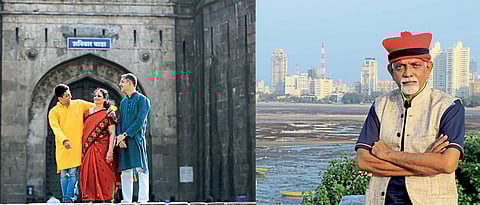

Separated by a three hour long road journey and a winding ghat, Mumbai and Pune are as different as chalk and cheese. When the twain meet, in person or on social media, what ensues is a battle of wits, characteristics and temperaments. There is no clear-cut winner here; but both the cities take pride in their follies and foibles and what makes them truly unique.
The Puneri Bana
If you take the jokes circulating on social media seriously, then the true-blue Puneri is curt, aloof, snooty, stingy, and has an opinion on everything under the sun. When asked about this, Shruti Mehendale retorts, “Isn’t this too far-fetched?”. Her husband, Shreenand responds, “We laugh at the Joshi Ajoba-Lele Kaku jokes and get on with our work.”
So who or what makes a Puneri? “I think Punekars are reserved, but helpful. We are friendly, but really not the type to go interfering in other people’s lives. We have always had time for family. We enjoy and understand good literature, music, dance, and theatre,” respond both husband and wife.
Their 22-year-old son, Deep, is more forthcoming. “In Pune, you just can’t be an engineer — you are expected to dabble in arts, pick up a skill, prove something to your peers. We have the best of everything. There’s so much happening in the city — art shows, theatre, music, fashion shows, adventure sports etc. Mumbai may have its playwrights, but when it comes to casting, they have to pick actors from Pune,” says the lad, who also did a stint with theatre, and is now hoping to join the Defence force.
“When I appeared for the Defence exam this year, there were about 12 kids from Maharashtra. Of them, seven were from Pune, and two from Mumbai. There’s no ‘ghulami’ in our blood,” he says with great pride.
Pune has been blessed with a favourable topography, good climate, good water. Speaking of water supply, Shruti says, “You will have to agree that the water of Pune tastes simply good. In school vacations, when we went to Sangli, my mom’s native place, we would carry a bottle of Pune’s water and drink from it surreptitiously, trying to preserve it as long as our holiday lasted.”
But if at all, Pune has to imbibe something from Mumbai, it would be their work ethic and discipline. “I spent about a year and a half in Mumbai, at the beginning of my career, and I was awed at how disciplined the Mumbaikars were. No one would jump the queue while getting into the BEST bus. The frequency of the buses was amazing. Our PMPML bus transport has to learn a lot from BEST,” opines Shreenand.
“But the quality of life here is much better,” he adds. His wife, Shruti seconds, “We don’t have to travel insane distances here. Whatever your requirements, they are all met in the neighbourhood.”
Hello from Camp
Before Kalyani Nagar and Koregaon Park mushroomed into Pune hotspots, MG Road on the Camp, was the place to be. Camp or Cantonment, which fell within Defence authority’s limits, was cosmopolitan then, and continues to be so even now. Theatre practitioner Mahrukh Bharucha, who has lived in Camp before moving to Bund Garden, says, “Camp is a melting pot of different communities that happily co-exist. One can walk a few hundred metres and hear at least four different languages spoken. The architecture is distinct and the general energy in the area is charged with a special sort of positivity.”
Unlike the perception of many migrants that Punekars are a very ‘closed community’, Bharucha says, “Pune has always been welcoming to a vast and varied sets of people from all over India as well as from the international community. Our entire growth has been due to the fact that people who come here on a temporary term choose to remain here permanently.” And, despite the industrialisation in the city, boom in the IT sector and a spurt in private colleges, Punekars are easy going people and enjoy their laid back approach, opines the dramatist.
“The soul of a city are its citizens. We give our city her personality, her ethos, her fibre. Our attitudes, cultural diversity, tolerance and characteristics shape us and consequently shape our city. My idea of identifying with her is: You can take Mahrukh out of Pune but how can you ever take Pune out of Mahrukh!?” she makes a point.
Best of the two
Actress Vibhawari Deshpande, has one foot in Pune and another in Mumbai. So she quite happily lists the positives of both the cities. “I am born and brought up in Pune; there’s a nutritive atmosphere as far as culture is concerned. Pune has the talent and Mumbai is the place to showcase it. That’s inevitable,” she begins.
She then goes on to explain the professionalism and the solid work ethic that Mumbaikars are known for. “If you are an artist, living in Pune, you are always in a cocoon. Everybody knows you. There is a certain thing about being Vibhawari Deshpande or Vibha tai. But in Mumbai, when you go in for an audition, somebody throws a paper scribbled with lines, and asks you ‘to say it’. These are realities of both the cities. And somebody like me needs both,” says the Harishchandrachi Factory fame actress.
Clicking her fingers, Vibhawari says, “In Mumbai, you see the pace at which the city runs, the approach that people have, their professionalism, the speed at which they work. Pune has a complete laid-back atmosphere. So it’s a crazy balance that I have to maintain between my Pune and Mumbai homes.”
Having said that Vibhawari loves the ‘coming home’ feeling that she gets when she is on her way back from Mumbai. “I cram my work, meetings etc in two or three days that I am in Mumbai and then I return home to my family and friends here. I don’t chill out that often in Mumbai,” she quips.
The teeming metropolis, for Vibhawari, is safe and non-interfering. “I have returned to Bandra from Powai at 2.30-3 in the morning when I was shooting for Tikli and Laxmi Bomb and I felt perfectly safe. My neighbours in MIG Colony are non-interfering. In Kothrud, where I stay, there is a lot of warmth amongst the next door neighbours. I miss that in Mumbai,” she says on a concluding note.
Sons of the soil
Call us tribals — the adivasis — we are the oldest and the original inhabitants of Mumbai, living in various settlements spread across the seven islands, that make up today’s Maximum City,” begins Vijay Worlikar, a Koli or a fisherman, and also the head of his community living in Worli Koliwada.
His community has seen the city change and how. “We Kolis are accepting of everyone who comes to the city. We are the custodians of the health and wealth of Mumbai,” says Worlikar, referring to the revenue that the government earns from the fishing industry and also providing good, nutritious food to the denizens.
Mumbai is the dream city of many, and there’s a continuous influx of people from the other parts of the country. And, Worlikar, very proudly states, “Mumbait konihi upashi zhopayla jaat nahi (No one sleeps empty stomach in the city). You will find at least one Vada Pav stall open and operating throughout the night. If you have little talent, and are willing to work hard, then Mumbai will take care of you.”
That for Worlikar, is the spirit of Mumbai.
When it comes to his community, he is proud of their perseverance, hard work and that they have stuck to their rites, rituals and traditions. “We have our festivals, food and ensure that the traditions live on,” he points out.
With the passage of time, Worlikar is determined that the youngsters from his tribe, learn the tricks of their trade and also equip themselves with professional skills. “My wife is a doctor. My daughter is a physiotherapist, my son has studied marketing. We have progressed a bit, but it can’t be said for all of my community members. But I am sure it will happen, by and by,” he concludes.
Spirit of Mumbai
A thorough-bred Mumbaikar, author Kiran Manral says, “I still think of my city as Bombay. The cultural ethos of Mumbai remains the same as it was when it was Bombay — inclusive, pacy, hurried, syncretic,” she says. When asked who are the Mumbaikars, Manral says, “I think folks in Mumbai are focused, disciplined. There is a clear drive within every individual to make the best of their situation and to improve their life situation. There seems to be gritty survival hardwired into a Mumbaikar’s genetic coding. Come what may, rains, riots, Mumbaikars are off to work.”
This is what the rest of India would call the ‘Spirit of Mumbai’. “Mumbaikars never called it the Spirit of Mumbai. For us, it is just basic survival. Of course, the city’s infrastructure is collapsing, the traffic is horrendous, public transport is crowded, and inconvenient at times, the city’s roads are riddled with potholes, trees are cut down mercilessly. There needs to be urgent attention paid to our infrastructure, we will implode if it doesn’t happen,” she says.
And, the ever resilient Mumbaikars are taking charge in small ways. “The campaign to save Aarey, the Versova clean up drive — the citizens are stepping in,” she adds.
Savio Mascarenhas also airs similar thoughts. The Group Art Director at Amar Chitra Katha, shares an affinity with the city — with its local trains, the dabbawallas, the Vada Pav and Bhelpuri. “For me, the soul of the city is the local trains. We spend one third of our lives on these trains, where the commuters are family — with whom we celebrate Dussehra, Diwali, birthdays, anniversaries and also retirements,” says he.
It’s the energy of the city that interests the artist. “In this city, sometimes you will see the strongest fall and the weakest stand tall. That’s the beauty of it. Mumbai is the biggest leveller of life. The richest of rich and the poorest of the poor jostle around to make a living. That’s where Mumbai derives it energy from,” adds Mascarenhas.
