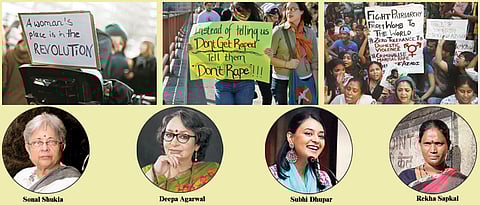

Feminism has many connotations and it is also misconstrued widely. The term may have come to us from the West (with the publication of Betty Friedan’s book The Feminine Mystique in 1963). But we have had homegrown movements too, beginning with the reform movements (abolition of Sati, widow remarriage) in the early 19th century. In the present times, we have managed to make some dent to the patriarchal mindset, but there are many more miles to be walked. Four women from different strata of society, but with independent minds of their own, tell us how they view feminism and what sisterhood means to them.
NOT ALL ARE PROGRESSIVE...
Sonal Shukla, Managing Director, Vacha — Voices of Girls and Women
The Indian women’s movement had its root in the struggle for Independence, where women were mobilised to speak up and fight for rights. But once we got Independence, they were encouraged to become homemakers,” says Sonal Shukla, describing the beginning of the movement.
The women later realised that those who talk of liberalism, human rights, democratic rights, are not so progressive when it comes to women’s rights. “The Indian women’s rights were ushered in a big way in the ’80s, and the Mathura rape case verdict was the trigger. But preceding the verdict, there were many socio-economic issues which were raised by the citizens. The Emergency was a big turning point, and leading to it were several movements like anti-price rise movement in Maharashtra and Gujarat, J P Narayan’s movement in Bihar and the Naxalite movement,” she says.
After Emergency was lifted and India voted Indira Gandhi out of power, there was a greater consciousness about democratic rights. “The very concept of what freedom meant had changed. You don’t have freedom because you have the right to vote. It also came to mean freedom for health and concerns for environment grew stronger. Therefore, all kinds of movements took root,” adds Shukla.
MATHURA RAPE CASE
“In 1972, the brother and the boyfriend of a teenaged Adivasi girl, Mathura got into a fight. They were taken to a police station where two policemen called Mathura for inquiry and closed the door. When Mathura came out, she said, she was raped. She and the policemen were taken to a hospital where it was proved that they had an intercourse. The Bombay High Court ruled that one policeman got one year’s imprisonment and another got four years. The one who got one year’s imprisonment said that he was too drunk to penetrate. At that time, only penetration was considered as a rape. In 1979, the Supreme Court reversed the judgement and set the police free,” Shukla explains.
Upendra Bakshi, a well-known jurisprudence expert, Veena Mazumdar, and four other people, wrote an open letter to the Supreme Court, about how wrong this was and the copies of that letter were sent to different organisations.
“In Mumbai, one organisation now defunct, got this letter. A lone woman on the committee called for an all India meeting over the crime. Fortynine women attended it and they were enraged to say the least. During discussions, it came out that it was not just rape, but total oppression of which rape was a part. They formed a forum. It was first called Forum Against Rape, later it changed its name to Forum Against Oppression of Women,” explains Shukla.
All this led to starting of women’s groups, coming together of academicians and well-educated females, and so on. Two journals, Feminist Network and Manushi, were started in this period. For a long time, women’s study group and women’s movement went hand in hand.
“Later, it was realised that you couldn’t sustain only on campaigns. That’s why NGOs were set up to advocate for specific rights. Somebody worked only for domestic violence; someone else for environment and women,” adds Shukla.
TAKE CHARGE OF YOUR LIVES
Deepa Agarwal, Author
Feminist has become a label which does not always describe women’s struggle for equality accurately. I think a ‘feminist’ would be a woman fighting for the right to make her own choices in life. This was not so easy in the ’60s and ’70s when there was immense societal pressure to get girls married young,” says Deepa Agarwal, who has written about 50 books so far and counting.
Marriage invariably meant subservience to your husband and in-laws and little support from your natal family if you faced problems. The women who rejected these traditional roles and sought careers over marriage were rebels in the true sense. You could combine both but it depended on how you managed the balancing act.
“It is both your individual circumstances and personality traits that shape you. Most girls are conditioned to embrace the roles patriarchy has allotted to them. Some, however, are courageous enough to reject them and seek their own path. Sometimes women take up jobs but are unable to have control over their salaries. Others are forced to strike out on their own because of abusive marriages or other personal compulsions. They learn how to make their own decisions and take charge of their lives,” the Delhi-based author explains her thoughts on feminism.
Talking about the influence of the ideology on her writing, Agarwal says, “It did influence my writing to a great extent but there were other factors as well. To begin with, the girls in my family were already comparatively emancipated. We were all educated to take up careers and almost all the women in my family had jobs. I must mention that my Nani’s family was greatly influenced by Pandita Ramabai. When I joined college, I became more aware of the extent of discrimination against women. After I got married and had three daughters, I could not help feeling concerned about their future in the prevailing patriarchal system.”
Agarwal also volunteered at Manushi, the feminist journal, for some time and her first poems, stories, articles and translations were published there. “The fact that gender stereotypes are shaped in childhood always stayed at the back of my mind. My first book Ashok’s New Friends was on the theme of portraying boys and girls as equals and since then I have tried to provide inspirational girl characters. I also prefer writing about strong women from history like Rani Lakshmibai, Nur Jehan or Ra’na Liaquat Ali Khan, so girls become aware that there are many possibilities for them.
However, the challenges for the women of this generation too are immense. “The way crimes against women are multiplying, it’s almost as if there’s a patriarchal backlash. More women may be coming into the work force, but sexist attitudes in offices remain a problem. The recent issue concerning women in command positions in the armed forces highlighted the fact that we are still not considered at par with men in many professions,” she says.
WOMEN HAVE TO STAND BY EACH OTHER
Rekha Sapkal, Waste picker
On most days, when our daily operation is running smoothly, we rarely bother about the maushi, tai (or didi). But the day they don’t come to clean up the trash we have generated, we suddenly wake up to their presence. We have a hazy idea of the lives of these women (and men) who clear our trash — they are the lowest on the socio-economic indices; often battered housewives with several mouths to feed for. But this image is not a complete one.
Rekha Sapkal, a waste picker contracted by the Pimpri Chinchwad Municipal Corporation, readily admits to the reality of their lives mentioned above. But all the adversities have only served to enhance her self-worth. A member of the Kagad Kach Patra Kashtakari Panchayat (KKPKP), she has found the much-needed support amongst the sisterhood.
“My husband has a battle with the bottle. I have six children — four girls and two boys. Over the years though, I have learnt not to take things lying down. My daughters are getting education, one is studying to be an engineer,” says Sapkal.
Helped by KKPKP members, Sapkal now puts forth the grievances of her co-workers before the authorities. When asked about the nature of the grievances, the 38-year-old says, “Some issues are about the route we have to follow, the teams that we work with and then there are cases of exploitation.”
Giving us an example, Sapkal says, “A new woman had joined us and I noticed that she was tensed. I gently prodded until she told me that her supervisor had an eye for her. He would call the woman into his cabin, talk dirty and even changed her duty hours so that she stayed longer at the workplace. The woman was not sure how to deal with his advances and she was also worried that if her husband and family learnt about this, she would be stopped from working. We have now lodged a complaint. The woman is not a member of KKPKP, but she is in distress and we women have to stand by each other.”
The doughty Sapkal has also learnt to be prudent and take into account all facts before fighting for their rights. “We have to be sure that both women and men are speaking the truth, that the grievances they have suffered are genuine. When we meet the authorities, we speak quietly, one by one, raising points clearly. Once you explain everything politely, most officers agree with our views,” she adds.
On the job though, the story of Sapkal and her colleagues, is like that of any working woman. She leaves home around 5.30 am to catch a bus and later a share rickshaw to reach her work place. Her work day starts at 7 am and ends around 3.30-4 pm.
“Most people we meet are co-operative. But some treat us like the dirt that we pick. We speak gently most of the time, sometimes a little sternly and then that brings about a change in their behaviour. Not many people do composting, they don’t even segregate wet waste from the dry. Working woman like you don’t have the time, do you? she asks.
ALL FAITHS TEACH YOU TO LOVE YOUR FELLOW-BEINGS
Subhi Dhupar, Regional Co-ordinator, United Religions Initiative North India and Afghanistan
A young female working in the inter-faith harmony area, a peace builder, is not a common sight. Especially, a single 28-year-old who loves dressing up. Her abilities, know-how of her work come under scrutiny then.
“At 24, when I joined the work force, straight after my Masters, I wasn’t taken seriously. My age, my identity all went against me,” says Subhi Dhupar, who hails from Jabalpur in Madhya Pradesh.
She was like a son to her family, and from an early age, she wanted to do something for communities. “In Jabalpur, there are very strict demarcations on the lines of gender, religion, education and socio-economic background. I come from a middle-class family, which has often struggled with socio-economic issues. I decided to work on peace building by bringing people together to start a dialogue and in the process, address social issues like healthcare, environment and education. This was not a conventional career choice like becoming a doctor. My parents still struggle to understand the nature of my work. This inter-generational gap is also evident in my work,” adds Dhupar.
In her work as well as personal life, she has always tried to negotiate and balance out. “I have to work with a variety of stakeholders like the UN body, Indian government and the people. So I wear more Indian dresses, I have perfected my khari Hindi boli and when necessary, I become someone’s didi, friend. I work through a prism of relationships,” she says.
The funds are also an important part of her work because once they dry up, the work suffers. “Peace building is a long term process, you can’t let it stop mid-way. After the Godhra riots, there was plenty of funding and various projects for the betterment of communities were initiated. But once the fundings stopped, the initiatives got stalled. This is what we are witnessing in the aftermath of Delhi riots too. Many people have come forward to donate, but once the frenzy dies down, all of this will collapse. What will endure is the relationships between these diverse communities,” she says.
The youngster believes that the hard-lining of identities that we saw in the capital will not dissolve in the near future. But the role played by women is a silver lining. “Women have come out as peace builders. Their whole refrain was, ‘our community has been discriminated against, we don’t know what our future is going to be like, but we will fight till the end’. The haq ki ladhai, has mainly emerged from women. They were crucial in rescue and assistance of people caught in conflict, they helped in collection and distribution of ration and other essentials,” Dhupar notes and adds that all the faiths teach their followers to love their fellow-beings and not kill each other.
