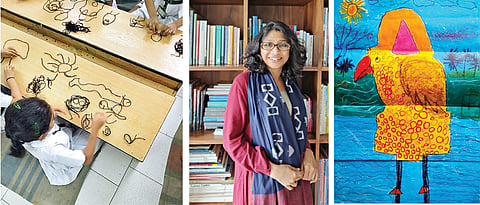

Art never was and still isn’t treated as a core subject in schools. Many are of the opinion that art does not come handy in any career that a student wishes to pursue. But such people probably don’t know that art is much more than drawing and painting; it imparts values to students, giving them the added benefit of having a creative mind that can be applied even in problem-solving. That’s why there is an absolute need to redefine the existing art curriculum and promote and integrate art education for all.
Art1st Foundation works towards this goal. Founded by Ritu Khoda, it recently collaborated with Federation of Indian Chambers of Commerce and Industry (FICCI) and Avid Learning to organise Art Education Roundtable (AER) in Mumbai.
AER aims to bring together diverse and experienced voices from the fields of art, pedagogy and policy making, to put together a vision for the integration of art into education in India, and help students develop visual thinking, inner expressions and creativity.
Talking to Khoda, we find out more about the work the foundation is doing and why is it important to focus on art in educational institutes.
Khoda says that through the workshops and events that the Foundation organises, they want to spread awareness about how inclusive and sensitive art education can nurture cultural awareness which will then enable the children to respect diversity and tangible and intangible heritage of everyone. Khoda has been engaging with parents, teachers, pedagogues, NGOs, foundations, and government bodies and explains that Art1st was established with a vision to create and develop a learning environment that nurtures and strengthen imagination, visual literacy and cultural awareness of children and the educators.
She adds that she has always believed that art is a powerful medium through which people can understand themselves and help transform the world around. Sadly though an art class is treated as an extra-curricular activity and is therefore given less importance. “One of the reasons that art has been sidelined is also that there are not enough trained educators and teachers who can help children let their creativity flow on the canvas,” Khoda points out.
To address this problem, the Foundation organises art education at school level to enhance the capabilities of teachers and define new standards for teaching and learning art.
Khoda says that they want to reimagine art education through a series of impactful outreach activities such as publishing children’s books, filmmaking, holding workshops, seminars and research, which would engender effective changes in children’s growth.
“The Foundation wants to create a platform for advocating the role of art education in schools, both private and government,” she adds.
Khoda points out that these days, thinking out of the box, being creative and imaginative has become a necessity to break free from the monotony. “Art is an amazing way to communicate with others because art in itself is a language and it is through art that one can express feelings and emotions,” she adds.
She explains that in the past few years, the Foundation has successfully developed special art education programmes, each suited for a different age group. “At the pre-school level, our interactive art labs help children explore and discover through sensory and visual experiences while the elementary programme focusses on high-level thinking skills which are central to responding to and making art, and a contemporary art programme for middle-school students that aims to heighten critical and creative transformative thinking,” says Khoda.
The Foundation has had successful workshops with students at schools across Mumbai and Delhi.
