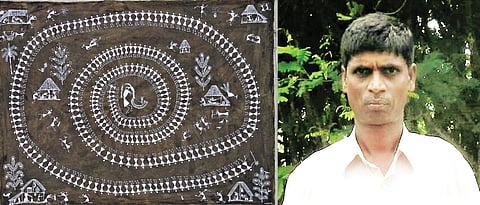

A search on social media by the name Balu Jivya Mashe shows his popularity scale. Every site aimed at promoting folk arts has an article or interview about Balu, his father, Jivya Soma Mashe and his older brother Sadashiv.
The folk artist in Jivya, a tribal from the Dahanu-Palghar belt (near Mumbai), was discovered by one Bhaskar Kulkarni, a field worker of crafts board. Jivya first exhibited his warli art in Chemould Art Gallery in the 1970s and since then he has gone places.
Now, his sons, Balu and Sadashiv have been tapped by a new venture of Tribal Art Forms, a brain-child of Mandira Lamba and Riddhi Bhalla of Blueprint12 and Rasika Kajaria of Exhibit320. They have put up a show in New Delhi called ‘Given power — From tradition to contemporary’.
Sadashiv is currently in Japan, for an art residency programme, so his younger brother, Balu speaks to us. “Traditionally, this art was painted on walls of our huts, especially during the harvest season and when there was a marriage in the family. Now, of course we paint a little everyday. We also cultivate our paddy fields during the rainy season. So October-November is the period when we actually get more time to devote to this art form,” says Balu.
Since they are also exhibiting warli art in galleries in India and abroad, the Mashes have taken to painting the traditional symbols of circles, triangles and chowks on manjarpat (a coarse fabric). Originally, the art form was practised by the womenfolk, but ever since Jivya introduced the warli art to urban audiences and won accolades, it’s the men in the tribal belt, who have taken it up seriously.
When asked about it, Balu says, “This art form was the preserve of married women. They still paint but not for exhibitions. My sister also paints, but not on manjarpat. She decorates the house.”
The workshops on the art forms is held regularly in the city; it’s now also being taught in drawing period in schools. But Balu says, “They don’t have jankari (know-how) of the art. We tell stories of the jungle, of animals and birds, sun and moon through warli paintings.”
He also doesn’t sound enthusiastic when we ask him about the art being learnt by youngsters. “There are youngsters who are learning warli. But they are not enough. We know a few artists who are working on manjarpat like us — Kishan Patani, Dadu Ladkya Dhumala and Dagdu.”
Balu also prefers to stick to the traditional way of painting and working on canvases instead of other surfaces so that the art can woo more urban buyers.
“We still use ricepaste to paint our designs — white on red (geru) surface. That’s what we know the best,” he concludes.
About Tribal Art Forms
Two contemporary galleries, Exhibit320 and Blueprint12, have come together to create a platform for folk and tribal art — Tribal Art Forms (TAF). Motivated by their passion and belief, that, through the traditional arts, they may shape a more humane world, gallerists Rasika Kajaria, Mandira Lamba and Ridhi Bhalla have ventured into this genre.
‘Given power — From tradition to contemporary’, is a show on behalf of TAF, which endeavours to showcase a selection of works collected from the interiors of Madhya Pradesh, West Bengal, Bihar and Maharashtra. The work offers an invitation to the reader to discover other regions and artists that epitomise the incomparable diversity of the contemporary tribal and popular Indian art.
They are exhibiting master folk artists and their immediate apprentices. The show also marks the launch of the website www.tribalartforms.com It is an online platform for selling art that connects the artist with the art enthusiasts and acts as a one stop shop.
