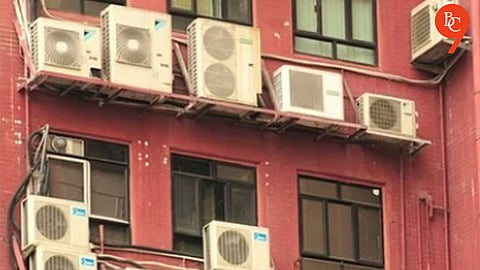


India can avoid major power shortages and help consumers save up to ₹2.5 lakh crore over the next ten years simply by doubling the energy efficiency of air conditioners (ACs), according to a new study.
The India Energy and Climate Center (IECC) at the University of California, Berkeley, in its study titled Beating the Heat: How Air Conditioner Efficiency Standards Help India Avert Power Shortages and Cut Consumer Bills, notes that India installs 10–15 million new air conditioners each year, and an additional 130–150 million units are projected to be added in the coming decade.
Air conditioners are rapidly emerging as the dominant factor behind peak electricity demand, accounting for as much as 60–70 gigawatts (GW), or about 25%. The authors noted that ACs are highly energy-intensive, each using roughly 100–150 times more electricity than an LED bulb.
On May 21, an intense and persistent heatwave sweeping across vast regions of India drove the nation’s power grid to a new peak, breaking electricity demand records for the fourth day in a row. India’s peak power demand surpassed 270GW on Thursday, rising from Wednesday’s high of 265.44GW, according to the power ministry, as the India Meteorological Department (IMD) cautioned that severe daytime heat will continue throughout the week.
According to the authors, in the absence of policy measures, air conditioners alone could account for 120 GW of peak power demand by 2030 and 180 GW by 2035, representing more than 30% of the country’s projected peak electricity demand. “ACs are already contributing 60 to 70GW to peak demand, and their growth is outpacing the grid’s ability to keep up after sunset,” said Nikit Abhyankar, the study’s lead author and UC Berkeley faculty member.
He warned that, without action, we face the possibility of blackouts or expensive last-minute repairs. However, he added that with well-designed policies, this challenge can be transformed into a benefit for consumers, manufacturers, and the power grid.
The Bureau of Energy Efficiency’s 2028 revision of air conditioner efficiency standards increases the minimum energy efficiency requirement by 25%, equivalent to one star.The study recommends a long-term roadmap that steadily tightens efficiency requirements so that, by 2033, the most efficient air conditioners currently available in India (exceeding the present 5-star rating/ISEER 6.7) become the minimum standard.
This roadmap has the potential to cut peak demand by 10 GW by 2030 and 47 GW by 2035—roughly the output of 100 large power plants—resulting in an estimated ₹8 lakh crore ($80 billion) in savings from avoided power infrastructure investments.Energy-efficient air conditioners also provide major advantages for consumers. Although their initial purchase price may be slightly higher, they are projected to generate net savings of ₹90,000–2,40,000 crore ($9–25 billion) by 2035, effectively recouping their cost within two to three years through reduced electricity bills, according to the study.
“Many people worry that more efficient air conditioners will cost more,” said Amol Phadke, co-author and faculty member at UC Berkeley. “However, our examination of global markets, including India, indicates that efficiency is not the primary factor determining retail prices. With appropriate policy support, greater efficiency can align with lower costs as manufacturers increase production, supply chains develop, and markets become more competitive,” he added.The market is already evolving. More than 1,000 air conditioner models currently exceed India’s existing 5-star efficiency benchmark, with a significant share manufactured by domestic producers.
In urban India, roughly 10% of households currently own an air conditioner, a figure that climbs to about 25% among higher-income groups, with substantially greater adoption already visible in cities like Delhi, Mumbai, and Bengaluru.
