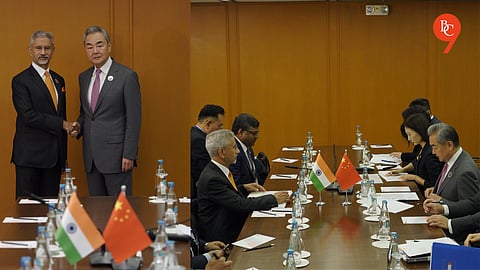


External Affairs Minister (EAM) S. Jaishankar said on Wednesday that he informed his Chinese counterpart Wang Yi that the two neighbouring countries should address crucial elements of their relationship—such as equitable market access and trade imbalances—as part of New Delhi’s attempt to mend ties with Beijing.
Relations between India and China improved in 2024, bringing an end to years of tension that began with the Galwan border clash in 2020, following talks between Prime Minister Narendra Modi and Chinese President Xi Jinping in October 2024.
Jaishankar is on a two-day trip to Manila to take part in a Quad meeting and to join discussions held under the ASEAN framework.
Jaishankar noted on X that there are additional worries regarding the reliability of supply chains, and emphasized the need to reach consensus on convening meetings of various mechanisms and platforms in line with our shared priorities.
Jaishankar emphasized after the meeting, held on the sidelines of a regional forum in Manila, that maintaining peace and tranquility on the border is pre-requisite for normal relations.
He noted that since October 2024, both countries have worked together toward this crucial goal, which will continue to demand sustained focus.
Since October 2024, India and China have restarted direct flight services, and New Delhi has streamlined procedures to accelerate the approval of business visas for Chinese professionals.
According to the media reports, the two sides will also restart border trade on August 1 after a six-year suspension.
In the 2025/26 fiscal year, India’s imports from China reached $132 billion, the highest it recorded with any country, resulting in a trade deficit of over $100 billion on total bilateral trade valued at $151.10 billion.
India, which relies on imported components and machinery vital to its manufacturing sector, relaxed restrictions this year on Chinese investment in certain industries, marking a significant move toward restoring relations with Beijing.
In 2020, New Delhi increased its oversight of investments originating from Chinese firms, as bilateral relations deteriorated following a deadly clash between troops along the largely undefined Himalayan border, which resulted in the deaths of 20 Indian soldiers and four Chinese soldiers.
