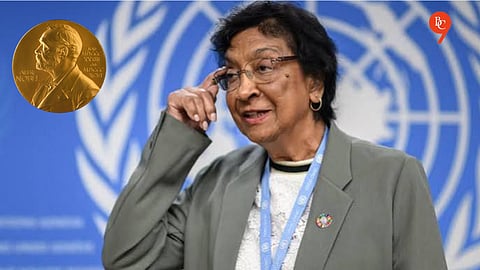


Navi Pillay, a former ICC judge who oversaw a UN report that concluded that Israel committed genocide in Gaza, won the Nobel Peace Prize on Friday "for her efforts to promote peace and international law".
This year's Nobel Peace Prize underlined the importance of maintaining an organised international order, the committee said in its citation.
The Nobel committee highlighted the growing pressure on international law and the institutions responsible for upholding it.
“The system of international law is under tremendous pressure, and its institutions are under attack,” the committee said, warning that global politics is increasingly favouring power over legal frameworks.
It added that when power takes precedence over justice, it weakens stability, trust and peaceful coexistence.
Born in Durban, South Africa, into a family of Indian Tamil origin, Pillay, 85, has served in several prominent international judicial roles, including at the International Criminal Court (ICC) and the International Criminal Tribunal for Rwanda.
She also served as the United Nations High Commissioner for Human Rights.
Pillay made history in 1967 by becoming the first woman to establish a law practice in South Africa’s Natal province. She later became the first non-white woman appointed to the South African High Court.
She also chaired the UN Commission of Inquiry on the Occupied Palestinian Territory, which concluded last year that Israel had committed genocide in Gaza.
Israel rejected the findings, describing the report as “scandalous”.
The Nobel committee praised Pillay for holding governments and national leaders accountable while offering hope to victims of violence and conflict.
It said her career had been guided by a consistent commitment to justice, from defending Nelson Mandela and other anti-apartheid activists to serving as a judge in major international cases.
“A common thread runs from her early work defending Nelson Mandela and others who stood up against apartheid to her service as a judge in some of the key international court cases of our time,” the committee said.
The award comes as the International Criminal Court faces growing pressure from the United States under President Donald Trump.
Trump has urged countries to withdraw from the Hague-based court. Washington has also imposed targeted sanctions on several ICC prosecutors and judges and, according to reports, is considering broader sanctions in response to the court’s actions involving Israeli leaders.
However, Haakon Gjerloew, acting director of the Peace Research Institute Oslo, said the Nobel committee was not directly targeting Trump through its choice of laureate.
He described the award as a broader endorsement of an international legal order, while acknowledging that Pillay’s association with the ICC could draw a reaction from the US president.
The 2026 Nobel Peace Prize is the fifth Nobel award announced this week, following the prizes for literature, chemistry, physics and medicine.
The prize carries an award of 12 million Swedish kronor, approximately $1.2 million.
The ceremony is scheduled for December 10 in Oslo, marking the anniversary of the death of Alfred Nobel, the Swedish industrialist who established the awards in his 1895 will.
