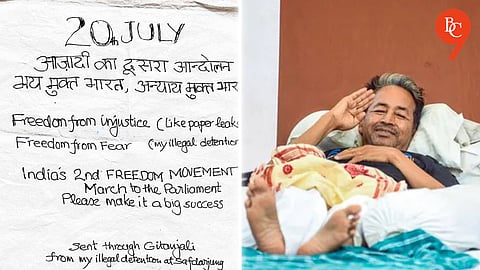


Ladakh-based activist and educator Sonam Wangchuk has described Monday's planned march to Parliament as India's "second freedom movement," urging supporters to turn the mobilisation into a massive show of strength. The appeal, shared in a handwritten note from Delhi's Jantar Mantar, comes as Wangchuk continues an indefinite hunger strike that has now stretched past three weeks.
Wangchuk has been on an indefinite hunger strike demanding the resignation of Union Education Minister Dharmendra Pradhan over alleged irregularities linked to the NEET-UG paper leak. What began as a protest over the exam leak has since widened into a broader campaign for reform of India's education system.
His wife, Gitanjali Angmo, said at a briefing outside Delhi's Safdarjung Hospital that the movement had "gone beyond the issue of the NEET paper leak" and was now aimed at "awakening the conscience of the whole country" on the state of education governance.
Wangchuk's fast has taken a visible toll on his health, and he was recently moved to Safdarjung Hospital by Delhi Police. Despite this, Angmo confirmed that the July 20 march to Parliament remains "confirmed," adding that Wangchuk had refused electrolyte powder offered by doctors and continued his fast regardless. In an earlier video message from the protest site, a visibly fatigued Wangchuk had appealed to supporters directly: rather than urging him to break his fast, he asked them to instead join the march.
The protest began as the satirical Cockroach Janta Party (CJP) campaign before evolving into a larger movement after Wangchuk joined and launched his indefinite hunger strike. The protest has attracted support from politicians, artists and civil society members, with the "Sansad Chalo" march seen as its next major milestone. The turnout on July 20 is expected to determine the movement's future momentum.
