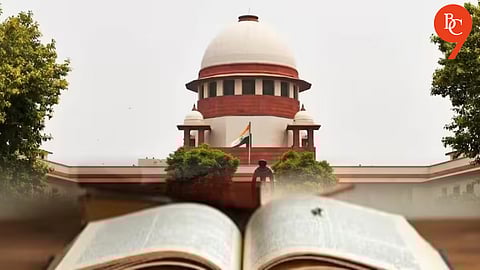


On Thursday, the Supreme Court imposed a comprehensive prohibition on the Class 8 NCERT social science textbook, which contained contentious sections, including a chapter discussing 'corruption in the judiciary.'
In addition, the Supreme Court panel headed by Chief Justice of India (CJI) Surya Kant, along with Justices Joymala Bagchi and Vipul M Pancholi, instructed the prompt confiscation of the textbook's physical copies and called for the removal of its digital editions.
The court has sent show-cause notices to the director of the National Council of Educational Research and Training (NCERT) and the secretary of the department of school education, questioning why criminal contempt proceedings should not be started in this case.
What the Supreme Court stated during the NCERT hearing:
• ‘We would like to have a deeper probe’: The Supreme Court called for a more thorough investigation into the issue, suggesting the existence of a 'deep-rooted conspiracy' aimed at tarnishing the judiciary's reputation. 'We want a more in-depth investigation. We need to identify those responsible and determine who is involved,' Chief Justice Kant stated. He mentioned that the addition of the 'corruption in judiciary' section was a 'deliberate action'.
• ‘Heads must roll’: The court emphasized the need to hold those accountable for the incident. Chief Justice of India, Kant, stressed the importance of identifying those responsible for the publication. 'As the leader of the institution, I must determine who is behind this. Consequences are necessary, and I will not conclude these proceedings,' stated the Chief Justice of India.
• ‘No remorse but justification’:Solicitor General Tushar Mehta offered an apology in court regarding the incident, and the NCERT had previously issued a statement expressing regret for the 'inappropriate material.' 'In the suo motu case, we begin by offering an unconditional apology,' Mehta stated.
The Supreme Court bench remarked that the NCERT's response showed no regret. "We have reviewed the NCERT notice, and it contains no apology whatsoever. The manner in which this director has composed the notice suggests justification rather than remorse," the bench observed.
• ‘They fired gunshot, judiciary is bleeding’: The Solicitor General promised that the individuals responsible for drafting the two chapters would no longer be employed by the UGC or any ministry. However, the Supreme Court remarked that this seemed like a 'very easy' solution. 'That would be too simple, allowing them to escape without consequences,' the bench commented. 'They initiated the problem, and now the judiciary is suffering,' Chief Justice Kant responded to the Solicitor General.
• ‘We do not propose to stifle legitimate critique’: Throughout this, the Supreme Court emphasized that it was not trying to suppress any constructive criticism of the judiciary. "We quickly clarify that we do not intend the suo motu proceedings to hinder any valid critique or the right to examine the judiciary. We strongly believe that robust discussion contributes to the dynamic vitality of the institution," the court stated.
It stated that this 'judicial intervention' was intended not to stifle criticism but to 'maintain the integrity of education.' The Supreme Court bench remarked that it would be 'inappropriate' to subject students to a 'prejudiced narrative' at this stage, as they begin to 'explore the complexities of public life and institutional structures.'
