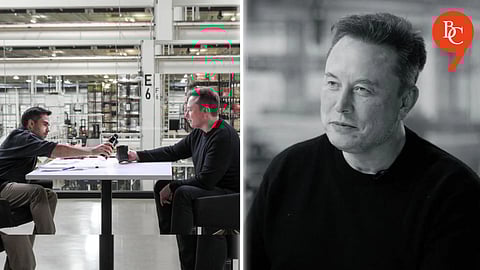


Recently, Elon Musk appeared on Zerodha co-founder Nikhil Kamath’s podcast People by WTF, where he predicted a future transformed by rapidly advancing artificial intelligence and robotics. The SpaceX and Tesla chief suggested that within the next decade or so, people may only need to work by choice, noting that this shift could arrive “in less than 20 years — perhaps even in 10 or 15,” as increasingly capable systems take over most forms of human labour.
"I think in the future, it won’t be the case that you have to be in a city for a job. My prediction is, in the future, working will be optional", Musk added.
Musk’s comments come at a time when India is locked in a heated debate over work culture. Prominent business leaders like Infosys co-founder Narayana Murthy and L&T CEO S.N. Subrahmanyan — have recently stirred controversy by advocating 70-hour and even 90-hour workweeks.
In a recent interview, Murthy cited China’s widely recognized 9-9-6 work culture to reinforce his longstanding belief that young Indians should put in longer hours to accelerate the nation’s growth. In contrast, Musk’s forecast that work may eventually become optional offers a differing viewpoint on the future of productivity and employment.
On Sunday (November 30), Musk sat down for an almost two-hour conversation with India’s billionaire Nikhil Kamath, co-founder of the discount brokerage Zerodha, on his podcast People by WTF. The wide-ranging discussion covered topics from the future of work and immigration policies, including the H-1B visa program, to Musk’s family, US tariff policies under President Donald Trump, and his vision for the world ahead.
City or Countryside? Musk Says Work Will Soon Be Optional
Kamath asked Musk whether people would prefer city life or rural living in the future. Musk said it would largely come down to personal choice, adding that physical proximity to jobs would soon no longer matter. “You won’t need to be in a city for work. In the future, working will be optional,” he said. When Kamath mentioned global moves toward shorter workweeks, Musk quipped, “Not me,” prompting laughter from both.
From Half-Weeks to Optional Jobs
Kamath asked what society might look like if people worked half the week. Musk predicted an even bigger change: “In less than 20 years, working at all could be optional like a hobby.” He compared it to growing your own vegetables versus buying them, saying work will be a matter of choice. Musk’s vision reflects his long-held idea of an “Age of Abundance,” where robots handle most productive tasks, letting people focus on what they enjoy.
At present, Musk’s comments offer a thought-provoking contrast to the current discussion on working hours, implying that while some leaders advocate for extended workweeks, technological progress might be guiding society toward the reverse trend.
