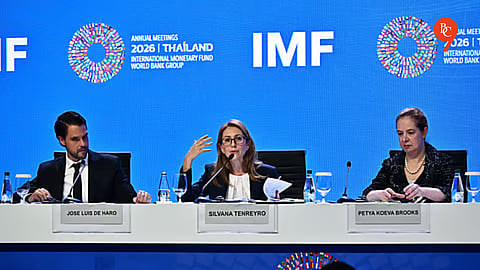


Strong demand for artificial intelligence (AI) has boosted economic growth in China, India and other Asian countries, helping global trade expand faster than it otherwise would have, the International Monetary Fund's (IMF) new chief economist Silvana Tenreyro said on Tuesday, Reuters reported.
Tenreyro was speaking to reporters during the annual meetings of the IMF and the World Bank in Bangkok. The rapid expansion of AI-related investment and trade had become a major driver of global growth, she said.
However, concentrated supply chains, high debt levels and potential financial market corrections could pose risks to the global economy, she argued.
Tenreyo said that global trade grew by 8.3% between 2023 and 2025, while trade related to AI expanded by 29% over the same period.
She argued that without the contribution from AI-related trade, overall global trade growth would have been just 4.6%, highlighting the technology's growing influence on international commerce.
The surge in demand for AI infrastructure, computing equipment and related technologies has supported economic activity across major Asian economies, including China and India.
However, the IMF has cautioned that AI supply chains remain concentrated in a limited number of countries and industries.
This creates potential bottlenecks and leaves global trade vulnerable to disruptions affecting key suppliers.
While AI investment has supported growth, Tenreyro warned that a correction in market valuations could weaken economic activity and create risks for financial stability.
Cybersecurity threats linked to AI could also weigh on growth and add to existing vulnerabilities.
The IMF's baseline forecast assumes that the current AI investment boom will gradually lose momentum. However, the organisation is also examining alternative scenarios based on the pace of productivity gains generated by the technology.
If sustained AI investment delivers substantial productivity improvements, those gains could support economic growth while limiting inflationary pressures.
In contrast, if investment remains strong but fails to generate meaningful productivity gains, the benefits to growth could be smaller and inflation could rise.
A reassessment of the expected profitability of AI investments could also reduce business demand and trigger a reversal of the current boom.
Beyond AI-related risks, Tenreyro expressed concern about elevated debt levels and urged governments to reduce budget deficits.
She also called for tighter monetary policies, including higher interest rates where necessary, to bring inflation back towards central banks' targets.
The comments underline the challenge facing policymakers: sustaining economic growth while managing inflation, public debt and financial vulnerabilities.
The IMF is updating its research on how AI could affect employment, Tenreyro said.
The technology could reshape labour markets as businesses adopt AI tools and automation. Its ultimate impact will depend partly on whether productivity improvements create new economic opportunities and how the benefits are distributed across industries and workers.
The IMF's assessment suggests that the AI boom could continue to support global growth, but its long-term contribution will depend on whether investment translates into lasting productivity gains.
