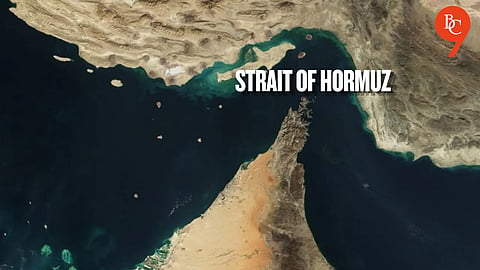


On Thursday, Iran announced alternative routes for vessels passing through the Strait of Hormuz. Tehran instructed ships to steer clear of the main shipping lane because of sea mine risks and follow the newly designated paths for safe transit.
Join our WhatsApp Channel to Stay Updated!
As part of a fragile two-week ceasefire, the country has agreed to temporarily permit passage through this strategic waterway, which handles roughly one‑fifth of the world’s oil trade. However, the main channel remains dangerous and uncertain for regular maritime traffic.
“All ships intending to transit the Strait of Hormuz are hereby notified that in order to comply with the principles of maritime safety and to be protected from possible collisions with sea mines...they should take alternative routes for traffic in the Strait of Hormuz,” Iran's Revolutionary Guards said in a statement quoted by local media.
Inbound route: Proceed from the Gulf of Oman northward toward Larak Island, then continue into the Persian Gulf (as illustrated on the map). Outbound route: Depart from the Persian Gulf, travel south of Larak Island, and then proceed toward the Gulf of Oman (as illustrated on the map).
The Strait of Hormuz, narrowing to about 33 km (21 miles), connects the Persian Gulf to the Gulf of Oman and serves as a crucial international shipping route. It handles supertankers transporting oil and gas from Gulf countries, including Saudi Arabia, Kuwait, Iraq, Qatar, Bahrain, the UAE, and Iran, most of which is exported to Asian markets like China. Although Iran and Oman control parts of the strait, it remains open to global shipping.
US President Donald Trump said American forces and equipment will remain in the Middle East until Iran agrees to a peace deal, warning that failure to comply could escalate the conflict. The US‑Iran two-week ceasefire allows temporary passage through the Strait of Hormuz, a key oil route, after Tehran blocked it since March, driving global energy prices higher.
