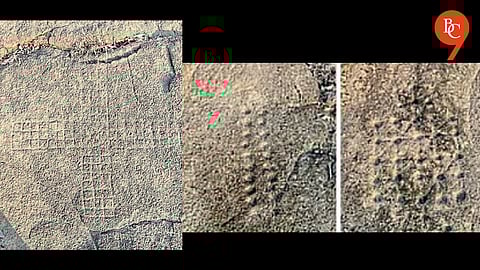


Pune, 18 December 2025: Ancient stone-carved game boards have been discovered on Moraya Hill near Lavale village in Mulshi taluka, revealing an important but neglected chapter of Maharashtra’s cultural history. These archaeological remains are currently exposed to natural weathering and human neglect, putting them at serious risk.
The site, locally known as “Ghoda Khadak,” features rock surfaces engraved with boards of traditional seated games. A total of eight game boards have been identified, including Mancala, Saripat, Tiger–Goat, and Chowk Bhara. Experts estimate that these carvings date from as early as the Satavahana period (around 250 BCE) to the Maratha era in the 17th century.
The site was first documented by heritage researcher Akash Marne, with further insights provided by scholar Sojwal Sali. Similar game boards have also been found on hill routes across Lavale, Pirangut, Bhukum, Marunji, Uravade, and other villages in Mulshi taluka. Among them, the massive stone game board at Marunji is believed to be one of the largest of its kind in the world.
Historians link these carvings to ancient trade routes that once connected the Konkan coast with the Deccan plateau. During the Satavahana period, these routes passed through Mulshi and were guarded by military checkpoints and resting places for traders. The game boards were likely carved at such halting points, serving as leisure spaces for soldiers and travellers.
The Ghoda Khadak area is also known for rock impressions resembling horse hoof marks, which gave the site its name. Other carvings, including a Shivling and symbolic figures, can also be seen nearby, adding to the site’s historical significance.
“These stone game boards are not just tools of recreation. They are silent witnesses to Maharashtra’s trade networks, daily life, and cultural continuity across centuries. Protecting them is not only the government’s responsibility, but a shared duty of citizens as well,” said Akash Marne.
Archaeologists and heritage activists stress that immediate documentation, protection, and conservation are essential to preserve this rare cultural legacy for future generations.
