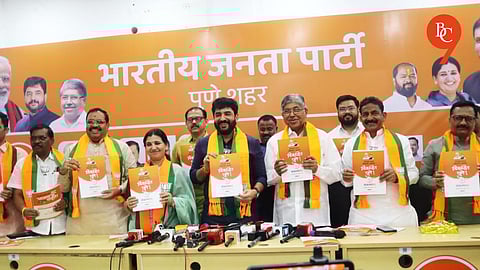

Pune, 8th January 2026: Yesterday, the Bharatiya Janata Party (BJP) released its manifesto for the Pune Municipal Corporation elections, outlining a development vision largely dependent on funding and support from the Central and Maharashtra governments.
The document highlights big-ticket infrastructure projects and welfare measures rather than initiatives driven by the municipal corporation’s own financial capacity.
The manifesto promises to develop Pune as a “Global Capability Centre (GCC) capital,” expand the metro network in all four directions, upgrade the airport, widen highways and deploy 4,000 electric buses to ease traffic congestion. It also proposes the use of artificial intelligence in civic services and promises affordable housing for the middle class.

The 34-page manifesto was released at a press conference attended by Union Minister of State Murlidhar Mohol, Higher and Technical Education Minister Chandrakant Patil, Minister of State for Urban Development Madhuri Misal, and BJP state general secretary Rajesh Pande.
A significant portion of the document highlights development works completed or initiated in Pune over the last decade under Prime Minister Narendra Modi and Chief Minister Devendra Fadnavis. The party claims that the scale of work done in the last ten years surpasses what previous Congress–NCP governments achieved over several decades.
Among future assurances are property tax exemptions for economically weaker families living in homes smaller than 500 sq ft, concessional metro and PMPML fares for women, free public transport for citizens above 75 years, and free health check-ups for all residents above 30 years.
The manifesto also mentions efforts to bring an AIIMS-level medical institute to Pune, extend the Khadakwasla–Kharadi metro line up to the airport, develop data centres near the Pune–Mumbai Expressway, and fast-track township projects and town planning schemes.
However, the manifesto has raised concerns over clarity and omissions. The mention that the existing 40 per cent property tax concession for first homes will continue only for the next five years has led to confusion about its long-term status. There is also no specific reference to slum rehabilitation or the Smart City initiative.
The document promises strict action against encroachments on footpaths and illegal hoardings, along with making the city flex-free. It also proposes observing a “Pedestrian Day” to improve road safety, even as the initiative has reportedly been discontinued in recent years.
Speaking at the event, Murlidhar Mohol said the manifesto is aligned with the vision of a developed Maharashtra by 2047 and emphasised that major projects such as metro expansion and airport development have been possible due to Central and State support. He expressed confidence that Pune voters would give the BJP another opportunity to lead the civic body.
