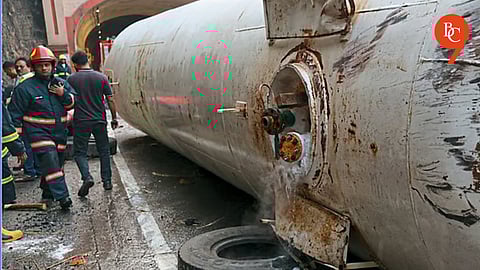


Pune, 5th February 2026: A serious shortage of technical equipment and skilled human resources led to a 32-hour delay in clearing an overturned gas tanker on the Mumbai–Pune Expressway, highlighting major gaps in emergency preparedness on one of Maharashtra’s busiest highways.
The tanker (NL 01 AG 4250), carrying around 20 tonnes of highly inflammable propylene gas, was travelling from Kochi in Kerala to Dahej in Gujarat when it lost control near a tunnel due to a downward slope. It hit a metal girder and overturned. One valve broke while the other two developed leaks, leading to continuous gas leakage.
As soon as the accident was reported, highway police, Khalapur police and volunteers reached the spot. Traffic was immediately stopped as a safety measure due to the high risk of explosion.
However, despite the urgency, authorities were unable to move the tanker or stop the leakage because of the absence of specialised machinery and trained experts.
Officials from IRB and the highway police chose not to take the risk of handling the tanker as it was filled with gas. The National Disaster Response Force (NDRF) was called and reached the site around 10 pm on Tuesday. However, the team also lacked adequate equipment to stop the gas leak, and the situation remained unchanged through the night.
It was only in the early hours of Wednesday that petroleum experts were contacted. A five-member team from Bharat Petroleum reached the site around 6.30 am.
Attempts to stop the leakage using standard rubber leak-arresting kits failed due to limited space around the damaged valve. The team then improvised by preparing a wooden mould matching the valve’s shape.
By around 8 am, leakage from the broken valve was stopped. The remaining two leaking valves were sealed by 9 am using bands and chemical coatings. Later, authorities decided to transfer the gas into empty tankers to reduce the risk.
The operation began around 4.30 pm, with about three tonnes of gas first removed. After partially lifting the tanker, another tanker was brought in to transfer the remaining gas.
The process continued late into the night, and traffic on the Pune–Mumbai Expressway was finally restored at around 2 am on early morning of Thursday, nearly 32 hours after the accident.
Chemical expert Dr Prasad Khandagale explained the severity of the situation, saying, “Propylene gas is heavier than air and stays close to the ground when it leaks. If temperature rises or a fire breaks out, it can lead to a major explosion. That is why a radius of 500 to 800 metres needs to be evacuated. Explosions can also generate large amounts of carbon monoxide, which can be fatal.”
