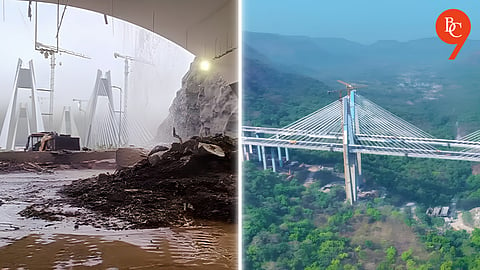


Barely two months after Chief Minister Devendra Fadnavis inaugurated the Mumbai–Pune Expressway's Missing Link and described it as "not a Missing Link but a Connecting Link," the ₹7,000-crore infrastructure project was temporarily shut after landslides triggered by heavy rain. The closure forced traffic back onto the old Khandala Ghat highway, the landslide-prone stretch the project was designed to bypass.
Built at a cost of ₹6,695 crore and inaugurated by Chief Minister Devendra Fadnavis on May 1, the 13.3-km, eight-lane Missing Link was designed to bypass the hazardous 19.8-km Khandala Ghat section of the Mumbai–Pune Expressway. The project features twin tunnels through the Sahyadri range, including an 8.92-km tunnel beneath Lonavala Lake recognised by Guinness World Records as the world's widest underground road tunnel, along with India's tallest road cable-stayed bridge across Tiger Valley.
The Maharashtra State Road Development Corporation (MSRDC) said the project would reduce travel time by 25–30 minutes, shorten the route by 6 km. At the inauguration, Fadnavis said it would eliminate dangerous bends in the Ghat section and landslide-prone sections while generating significant economic activity.
On Monday, heavy rainfall triggered landslides near the Khandala exit of Tunnel 2, prompting authorities to close the Missing Link. Although the tunnel reopened later that night following inspections, commuters were temporarily diverted to the old ghat section.
The State Highway Police reported that the landslide took place early Monday following prolonged rainfall. A retaining wall near the first tunnel on the Pune–Mumbai carriageway was damaged, allowing water to spill onto the road.
MSRDC officials maintained that the tunnel structure remained intact, saying the damage was limited to the external false frame near the tunnel entrance.
The Maharashtra State Road Development Corporation (MSRDC) attributed the incident to extreme weather rather than construction flaws. “This is not the contractor’s fault; it is nature at play,” Vice Chairman Anilkumar Gaikwad told The Indian Express. “The tunnel structure has not been affected, but the false frame – which is an external structure built at the edges of tunnels – has been damaged,” he added.
Officials said the IIT Bombay-approved rockfall protection system covered only the first 15 metres of the hillside, while the boulders fell from nearly 150 metres above, calling the incident an “act of God” caused by exceptionally heavy rainfall.
While officials insist the tunnel itself performed as designed, the incident has drawn attention to the project's overall resilience during extreme monsoon conditions. A corridor promoted as bypassing landslide-prone terrain was forced to close because of rockfalls near its approach within its first monsoon season.
The episode also shows the difference between the tunnel's structural performance and the vulnerability of surrounding infrastructure, including slope-protection measures and external support structures. As extreme rainfall events become more frequent across the Western Ghats, the closure is likely to prompt further examination of how such projects are designed to withstand increasingly intense monsoon conditions.
