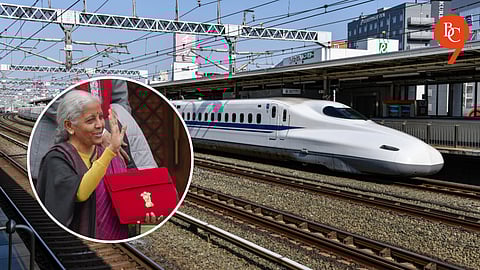


Pune, 2nd February 2026: Presenting the Union Budget 2026–27, Union Finance Minister Nirmala Sitharaman announced the highest-ever allocation of ₹2.81 lakh crore for Indian Railways.
One of the most significant highlights is the approval of seven high-speed rail corridors across the country, including the Mumbai–Pune and Pune–Hyderabad bullet train routes.
According to officials from National High Speed Rail Corporation, the detailed project reports (DPRs) for both corridors were submitted to the Railway Board in 2021–22 and have already received a positive assessment. As a result, no fresh DPR will be required, saving nearly three years in project preparation time.
The Mumbai–Pune–Hyderabad corridor will be developed in two phases to ensure faster execution. The Mumbai–Pune stretch will pass largely through tunnels due to the ghat section, while the Pune–Hyderabad segment will run on an elevated alignment.
Pune’s bullet train station will also be elevated and located outside the congested city centre, likely in the Loni Kalbhor or Hadapsar area, with direct connectivity to the Metro and the proposed Ring Road.
The entire corridor will span 711 kilometres, covering Mumbai, Pune, Solapur and Hyderabad. Stations are planned at Navi Mumbai (underground and linked to the airport), Lonavala, Kurduwadi, Solapur, Kalaburagi, Vikarabad and Hyderabad.
Once land acquisition is completed, construction will begin in phases, with the project expected to be completed within five to six years.
The high-speed rail network is expected to drastically cut travel times, Mumbai to Pune in just 48 minutes and Pune to Hyderabad in under two hours. The larger network will also connect major cities like Bengaluru, Chennai, Delhi and Varanasi through future corridors.
Beyond high-speed rail, the Budget places strong emphasis on safety and modernisation. The advanced railway safety system Kavach 4.0 will be expanded to more routes to prevent accidents and improve passenger security.
Freight movement will also receive a boost with the announcement of a new east–west dedicated freight corridor between Dankuni and Surat, aimed at supporting industry and port-led growth.
Funds allocated to the Railways will cover operational costs such as salaries, pensions, energy, maintenance and loan repayments, while a major share of capital expenditure will go towards new lines, track doubling, electrification, signalling upgrades, rolling stock, bridges, tunnels and station redevelopment.
The government said the focus remains on building a faster, safer and more reliable railway network, with balanced expansion across large cities as well as smaller towns.
