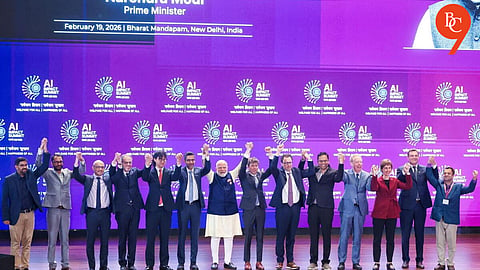


The five-day India AI Impact Summit 2026, which drew global attention from governments, industry leaders and policymakers, concluded in New Delhi with the adoption of the New Delhi Declaration on artificial intelligence. The declaration received backing from 88 countries and international organisations, underscoring broad international support for harnessing AI to advance economic growth and social good.
The Electronics and Information Technology Ministry of India (MeitY) emphasizes that the declaration aims to utilize AI for economic development and societal benefit, ensuring that the advantages of this technology are accessible to people worldwide.
"Guided by the principle of “Sarvajan Hitaya, Sarvajan Sukhaya” (Welfare for all, Happiness for all), the Declaration underscores that the benefits of AI must be equitably shared across humanity," the ministry said.
The agreement calls for stronger global cooperation on AI, respect for national priorities, and the development of reliable and inclusive systems, while promoting its use in governance, science, public services and economic growth.
The Declaration is built around seven key pillars that form the foundation of global AI cooperation:
1. Democratizing AI Resources
2. Economic Growth & Social Good
3. Secure & Trusted AI
4. AI for Science
5. Access for Social Empowerment
6. Human Capital Development
7. Resilient, Efficient & Innovative AI Systems
An International Network of AI for Science Institutions is planned to connect global research communities and accelerate the adoption of AI, with a focus on energy-efficient and resilient systems.
At the summit, India promoted its ‘AI for All’ approach based on equity, access, and global cooperation. Global leaders, tech companies, and startups participated in discussions on AI governance and innovation, with the New Delhi Declaration emerging as a key outcome to drive international collaboration in AI.
The New Delhi Declaration at the AI Impact Summit 2026 received support from 88 countries and international organisations. Participating countries include: Albania, Armenia, Australia, Austria, Belgium, Bhutan, Bolivia, Botswana, Brazil, Bulgaria, Cambodia, Canada, Chile, China, Croatia, Cuba, Cyprus, the Czech Republic, Denmark, Egypt, Estonia, Ethiopia, Fiji, Finland, France, Gambia, Germany, Greece, Guyana, Hungary, Iceland, India, Indonesia, Iran, Ireland, Israel, Italy, Japan, Kazakhstan, Kenya, Kyrgyzstan, Latvia, Liechtenstein, Lithuania, Luxembourg, Maldives, Malta, Mauritius, Mexico, Morocco, Mozambique, Myanmar, Nepal, the Netherlands, New Zealand, Norway, Oman, Paraguay, Peru, the Philippines, Poland, Portugal, Romania, Russia, Rwanda, Saudi Arabia, Senegal, Serbia, Seychelles, Singapore, Slovakia, Slovenia, South Korea, Spain, Sri Lanka, Suriname, Sweden, Switzerland, Tajikistan, Tanzania, Trinidad and Tobago, the UAE, Ukraine, the UK, the USA and Uzbekistan, along with the European Union and IFAD.
