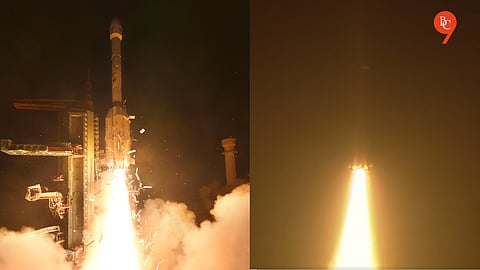


On Friday, ISRO once again entered the history books by successfully launching the nation’s first imaging satellite in geostationary orbit, deploying the more than 2,300 kg payload into an exact orbit with a GSLV rocket.
On its 19th mission, the Geosynchronous Satellite Launch Vehicle (GSLV) successfully deployed EOS-05 into the planned sub-geosynchronous transfer orbit 18 minutes after liftoff from the second launch pad at the Satish Dhawan Space Centre in Sriharikota at 2:55 a.m. on September 4.
EOS-05 is India’s first imaging satellite designed to observe the Earth from a geosynchronous orbit approximately 36,000 km above the surface.
ISRO Chairman Dr. V. Narayanan stated, "I am delighted to share that the GSLV-F17 launch vehicle has accurately and successfully placed the advanced Earth observation satellite EOS-05 into its designated orbit."
He further noted that this marks the 107th mission from the Sriharikota spaceport and the 19th flight of the GSLV.
The initial GSLV-D1 mission carried a payload of 1,536 kg. Since then, we have steadily enhanced the vehicle’s performance by reducing structural mass and upgrading its propulsion systems, and today we have successfully placed our heaviest satellite, weighing 2,367 kg, into orbit using this launch vehicle, he said.
The ISRO Chairman stated that once the Earth observation satellite EOS-05 is fully commissioned in orbit, it will serve as India’s first dedicated imaging satellite in geostationary orbit, delivering vital strategic information for the nation.
He added, “Satellite telemetry confirms that all valves are functioning correctly, the solar panel has been deployed, and the satellite’s overall condition is completely healthy.”
In the next few days, we will elevate the spacecraft to its designated orbit and position the satellite on the geostationary platform to support national operations," the ISRO Chairman stated.
The EOS-05 satellite, known as the 'Eye in the Sky,' will deliver real-time images and support applications in agriculture, environmental monitoring, disaster management, and other fields.
The successful deployment of EOS-05 is a major relief for ISRO, which had not conducted any launch operations since the PSLV-C62 mission carrying the EOS-N1 Earth observation satellite failed on January 12, 2026.
Following the consecutive failures of PSLV-C62 and PSLV-C61 on May 18, 2025, the space agency adopted a cautious stance and suspended all launch activities.
Although seven missions, including the GSLV-F17/EOS-05, were planned for the first quarter of 2026, ISRO did not launch any satellites.
The successful launch of the 2,367 kg EOS-05 satellite has effectively moved past the setback ISRO faced in August 2021 with the GSLV-F10 / EOS-03 mission.
At that time, the GSLV-F10 / EOS-03 performed as expected during its first and second stages, but a technical anomaly prevented the ignition of the cryogenic upper stage, resulting in mission failure.
The EOS-05 satellite now serves as a replacement for the unsuccessful EOS-03 mission.
