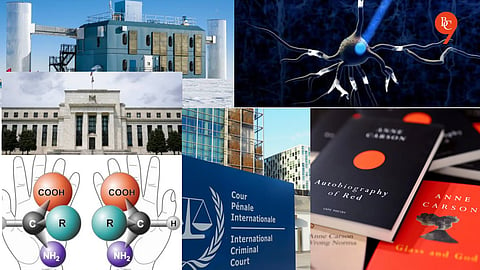


The 2026 Nobel Prizes recognise achievements spanning neuroscience, astronomy, chemistry, literature, international law and economics.
This year's Nobel recognition emphasis on how scientific discoveries, creative expression and research into economic policy can deepen our understanding of the world and help address complex challenges.
Physics, Chemistry, Physiology or Medicine, Literature, Peace and Economic Sciences, are major six categories in which Nobel Prize is awarded.
While each prize recognises a different contribution, the awards also reflect the evolution of ideas and research fields that have received Nobel recognition over the decades.
Winners: Karl Deisseroth, Peter Hegemann and Georg Nagel
Awarded for: Discoveries concerning light-gated ion channels and optogenetics.
The 2026 Nobel Prize in Physiology or Medicine recognises research that helped establish optogenetics, a technique that allows scientists to control the activity of nerve cells using light.
The technology relies on light-sensitive proteins known as channelrhodopsins. By introducing these proteins into selected cells, researchers can use light to activate or inhibit particular neurons with considerable precision.
Optogenetics has transformed neuroscience by allowing researchers to investigate how specific brain circuits influence movement, memory, perception and behaviour.
It can help scientists examine the neural mechanisms associated with neurological and psychiatric disorders.
Although it has significant research potential, many possible treatments based on the technique remain experimental.
Winner: Francis Halzen
Awarded for: Decisive contributions to the IceCube Neutrino Observatory and the discovery of high-energy neutrinos of astrophysical origin.
The 2026 Nobel Prize in Physics recognises Francis Halzen's work on the IceCube Neutrino Observatory, a scientific facility at the South Pole designed to detect neutrinos arriving from space.
Neutrinos are extremely elusive subatomic particles that interact only weakly with matter. They can travel enormous distances through the universe without being absorbed, carrying information about some of its most energetic events.
IceCube uses sensors embedded deep in Antarctic ice to detect the faint signals produced when neutrinos interact with matter.
Traditional astronomy relies heavily on electromagnetic radiation, including visible light, radio waves and X-rays. Neutrinos provide another way to investigate cosmic phenomena.
Their detection can help scientists study distant sources associated with powerful astrophysical processes, including black holes and other energetic objects. Neutrino astronomy therefore complements observations made using light, gravitational waves and cosmic rays.
Winners: Henri B. Kagan and Kenso Soai
Recognised for: The discovery of nonlinear effects and autocatalysis in asymmetric organic synthesis.
The 2026 Nobel Prize in Chemistry focuses on molecular chirality, a property in which molecules exist in two forms that are mirror images of one another.
These forms, known as enantiomers, may look similar but can behave differently in biological systems. The distinction is particularly important in pharmaceutical research, where two molecular forms can have different biological effects.
Henri B. Kagan's research advanced the understanding of asymmetric synthesis, while Kenso Soai demonstrated how autocatalytic reactions can amplify a preference for one molecular form over another.
Controlling molecular chirality is important for producing chemicals and medicines with the desired properties. Understanding how one mirror-image form can become dominant also helps researchers investigate fundamental questions about the origins of life's molecular asymmetry.
The research has implications for organic synthesis, catalyst development and pharmaceutical chemistry.
Winner: Anne Carson
Awarded for: Her bold and inventive body of literary work.
Canadian writer Anne Carson is known for combining poetry, prose, classical literature, translation and philosophical reflection. Her writing frequently moves across conventional literary boundaries, drawing on ancient Greek texts and ideas while exploring contemporary questions and experiences.
Unlike a scientific prize, which may recognise a particular discovery, the Literature Prize can honour a writer's broader body of work.
Carson's writing challenges conventional distinctions between poetry, essays, drama and scholarship. Her engagement with classical literature also demonstrates how ancient texts can be reinterpreted for modern readers.
Her work highlights literature's capacity to connect language, history, philosophy and creative experimentation.
Winner: Navanethem 'Navi' Pillay
Recognised for: Her efforts to promote peace and international law.
Navi Pillay, a South African jurist and former United Nations High Commissioner for Human Rights, has played an important role in international justice and human rights.
Her career includes work as a judge at the International Criminal Tribunal for Rwanda, where she contributed to the development of international criminal jurisprudence, including the recognition of sexual violence as an act that can constitute genocide under specific circumstances.
The 2026 award highlights the relationship between peace, legal accountability and the protection of human dignity.
International law provides mechanisms for investigating and prosecuting serious violations, including war crimes, crimes against humanity and genocide.
Pillay's work reflects the principle that lasting peace requires more than ending active hostilities. It also involves accountability, the protection of vulnerable populations and efforts to prevent grave abuses from going unpunished
Winners: Robert E. Hall and Michael Woodford
Awarded for: Research on the microeconomic foundations of macroeconomic stabilisation.
The 2026 Nobel Prize in Economic Sciences recognises work that has helped explain how decisions made by individual households and businesses shape the wider economy and how governments and central banks can respond to economic fluctuations.
Macroeconomic stabilisation refers to policies intended to limit economic volatility, manage inflation and support relatively stable economic activity.
Hall and Woodford's research has contributed to the theoretical foundations of modern macroeconomics and monetary policy.
Households and businesses respond to interest rates, prices, wages and expectations about future economic conditions. These decisions influence consumption, investment, employment and overall economic growth.
Understanding these relationships helps economists assess how policy changes may affect the economy. Central banks use related frameworks when setting interest rates and communicating monetary policy, while governments consider economic conditions when developing fiscal measures.
The research does not eliminate uncertainty, but it provides tools for analysing how policies may influence economic behaviour.
