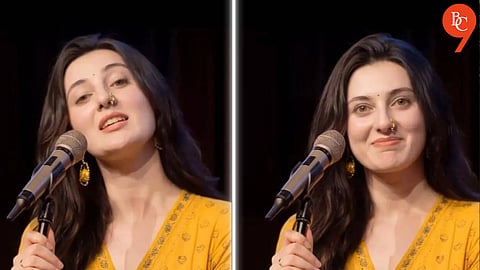


Dressed in a yellow kurta, a woman steps onto the stage, smiles at the crowd, and begins reciting an Urdu couplet into the microphone. “Khaandani raees rakhte hain mijaaz naram apna, khaandani raees rakhte hain mijaaz naram apna… tumhara lehja bata raha hai ki tumhari daulat nayi nayi hai,” she says, drawing loud applause from the audience. It has gone massively viral online, racking up 28 million views in just one day. The video has become viral, amassing 28 million views, but the woman featured is AI-generated, misleading millions of viewers.
The piece of shayari roughly translates to: “People with old money act with grace. Your tone makes it clear that your money is brand new.” The video was shared on Instagram by Tanvi Joshi, whose profile calls her a “Punjabi girl.” Millions praised the shayari and even debated the pronunciation of mijaz — “it’s mizaj,” several comments read.
The Real Voice Behind the Viral AI Shayari
The video featuring Tanvi Joshi reciting a couplet is not original. The audio was sourced from Marziya Shanu Pathan, a corporator with the Thane Municipal Corporation. Pathan had performed the same couplet at an event six days earlier and shared the video on Instagram. Ironically, the original video received fewer than 900,000 views, while Tanvi Joshi's version garnered 28 million views.
Pathan’s voice was used in an AI video that shows ‘Tanvi Joshi’ reciting the same shayari. “Aye thats my voiceeeeeee,” Pathan posted under Joshi’s viral video. Her comment led many to realise they were looking at an AI video.
The episode underscores how difficult it’s becoming to spot AI-generated videos. As artificial faces and voices grow more lifelike, concerns around consent, credit, and trust are intensifying — raising questions about who owns the words and who gets the recognition.
Even though current public AI tools still show minor flaws, newer systems are rapidly closing the gap between synthetic and real. The rise of convincing deepfakes has intensified debates around misinformation, political misuse, and digital ethics. Experts warn that as AI becomes more accessible, misleading content could spread faster than it can be verified, making media literacy and stronger authentication tools more crucial than ever.
