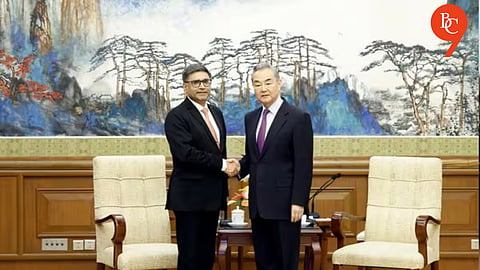


Foreign Secretary Vikram Misri held talks with senior Chinese leaders in Beijing on Monday as part of ongoing efforts by both countries to normalise relations, address key issues, and expand cooperation across various sectors.
Misri’s visit follows a meeting between external affairs minister S Jaishankar and his Chinese counterpart Wang Yi on July 22 on the margins of ASEAN-related meetings in the Philippines.
Jaishankar underscored that peace and stability along the border are essential for normal relations, while also voicing New Delhi’s concerns over equitable access to Chinese markets, a more balanced trade relationship, and greater predictability in supply chains.
Misri began his visit to China with a meeting with Sun Haiyan, vice minister of the international department of the central committee of the Communist Party of China.
They explored methods to further advance the implementation of the directions given by Prime Minister Narendra Modi and President Xi Jinping on bilateral relations, which include addressing matters of mutual priority and encouraging political, people-to-people, academic, and think-tank exchanges, the Indian embassy stated in a social media post.
Misri also held talks with Hong Liang, deputy secretary general of the National Committee of the Chinese People’s Political Consultative Conference, to explore ways to deepen bilateral engagement in both political and people-to-people spheres.
In the days leading up to Misri’s visit, the external affairs ministry firmly raised issues related to sovereignty, emphasizing that India has not infringed on China’s sovereignty, while Beijing continues to unlawfully occupy areas of the former state of Jammu and Kashmir and has undertaken projects in those regions.
India and China are slowly rebuilding their ties after a military stand-off on the Line of Actual Control (LAC) that lasted more than four years and took bilateral relations to a six-decade low.
After Modi and Xi met in Russia in October 2024, both countries restarted the Kailash Mansarovar pilgrimage and reinstated direct flights. India has also relaxed visa rules for Chinese citizens.
Over the past two years, India has been affected by China’s restrictions on exports of key commodities, including rare earth metals, fertilisers, and heavy machinery. New Delhi is also deeply worried about the highly unbalanced trade relationship with Beijing and has urged for smoother access to Chinese markets, along with measures to reduce the trade deficit, which has recently climbed to a record $112 billion. In FY26, total bilateral trade stood at $151 billion, but India’s exports accounted for only $16.6 billion of that amount.
