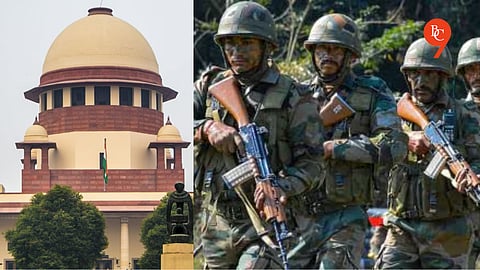


A group of paramilitary officers from Central Armed Police Force (CAPF) have approached the Supreme Court challenging certain provisions of the newly enacted CAPFs (General Administration Act).
They claim this law will enable restriction of CAPF officers in their career progression.
According to media reports of court documents, the matter has been listed by the apex court for hearing in the first week of August.
Officers and their legal representatives told PTI that a batch of writ petitions have been filed by about 3,000 cadre officials drawn from the five Central Armed Police Forces (CAPFs) like the CRPF, BSF, ITBP, CISF and SSB.
Argument for filling the writ petition is based on exercising the right guaranteed under Article 32 of Indian Constitution that allows citizen to approach Supreme Court to enforce their fundamental rights.
Petitioners which include gallantry medal winners and few women officers argue that new act does not embodies the spirit and substance of directives of Supreme Court's May 2025 verdict , and have sought declaration of sections 3 and 4 of CAPF (General Administration) Act, 2026 as “ultra vires” to the Constitution.
The Supreme Court, on May 23 last year, directed the Centre to progressively reduce the deputation of Indian Police Service (IPS) officers up to the rank of Inspector General (IG) in the Central Armed Police Forces (CAPFs) over a two-year period.
The court said the move would create greater promotional opportunities for cadre officers, observing that prolonged delays in their career progression were adversely affecting the morale of the forces.
Ministry of Home Affairs filed review petition in the court seeking to revist the decision.
The apex court later dismissed the Centre's review petition challenging the order.
In response, the Union government enacted the Central Armed Police Forces (General Administration) Act, which came into force in April.
The dispute centres on the career progression of nearly 13,000 CAPF cadre officers, many of whom reportedly wait 15 to 16 years for their first promotion. In contrast, an IPS officer may receive up to four promotions during the same period.
The legislation establishes a common legal framework governing recruitment and service conditions across all CAPFs.
While Section 3 deals with recruitment and service conditions, Section 4 empowers the Centre to amend the schedules of the Act.
Under the new law, 50% of Inspector General (IG) posts, 67% of Additional Director General (ADG) posts, and all Special Director General (SDG) and Director General (DG) posts are reserved for IPS officers on deputation.
Several CAPF cadre officers have objected to the new framework, arguing that senior posts, particularly at the ADG level, should be filled through promotions from within the respective forces based on eligibility, rather than being earmarked predominantly for IPS officers on deputation.
Defending the legislation, the Centre has maintained that the Act aims to replace the existing fragmented service rules with a uniform legal framework governing both CAPF cadre officers and IPS officers serving on deputation.
The CAPFs, which function under the Ministry of Home Affairs, are responsible for a wide range of duties, including border guarding, counter-insurgency and counter-terrorism operations, maintaining internal security, assisting state police in law-and-order situations, and conducting election-related security operations.
