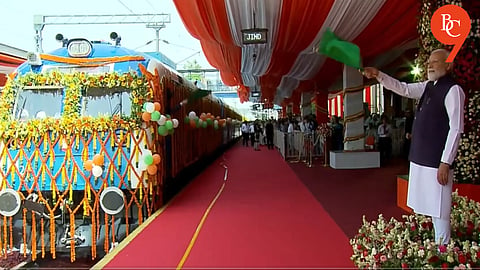


Prime Minister Narendra Modi flagged off India's first hydrogen-powered train on Friday, running between Jind and Sonipat in Haryana, marking a major milestone in the country's push toward cleaner rail mobility. Alongside the launch, Modi also inaugurated infrastructure projects worth thousands of crores in the region.
Unlike conventional electric trains that rely on overhead power lines, the Hydrogen Fuel Cell Trainset generates electricity onboard through a chemical reaction between hydrogen and oxygen. The process produces only water vapour as a by-product, making it an emission-free alternative to conventional rail transport.
Generates electricity onboard using hydrogen fuel cell technology.
Produces water vapour as its only emission.
Uses hydrogen supplied from a dedicated 3,000 kg-capacity hydrogen plant in Jind, produced through electrolysis.
Can accommodate up to 2,600 passengers.
Powered by an indigenously developed 1,200 HP engine, compared to 500–600 HP engines used in similar hydrogen trains globally.
Indian Railways says it is designed to be the world's longest and most powerful hydrogen-powered train.Part of a Larger Push
The project falls under Indian Railways' "Hydrogen for Heritage" initiative, which envisions 35 hydrogen-powered trains for heritage and hill routes, including a planned rollout on the Kalka-Shimla line. The Railways Ministry has earmarked around Rs 2,800 crore for developing this fleet, with each trainset costing roughly Rs 80 crore plus additional route infrastructure costs. Officials say running costs, higher for now, are expected to fall as the fleet scales up.
The launch builds on more than ten years of rail electrification, with over 99% of India’s broad gauge network now electrified and directly supports the National Green Hydrogen Mission and the nation’s Net Zero objectives. It also positions India within a select group of countries running hydrogen-powered trains, strengthening its bid to be a leader in sustainable mobility, even as diesel and coal remain significant in other segments of its transport system.
