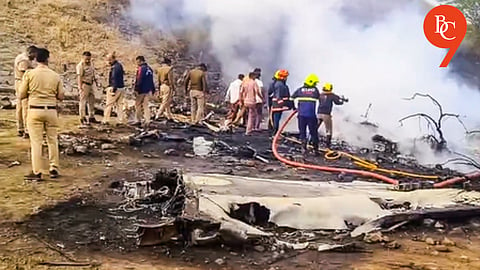


In the crucial minutes before the charter plane carrying Maharashtra Deputy Chief Minister Ajit Pawar crashed near Baramati airport on Wednesday, the aircraft’s captain spoke to Air Traffic Control and confirmed that the runway was visible, officials said, but there was no distress call or SOS from the cockpit before the fatal accident. The absence of an emergency signal and the nature of the final communication have become a key part of the investigation as authorities attempt to piece together what went wrong.
According to sources familiar with initial reports, the Bombardier Learjet 45 carrying Pawar and four others was due to land at around 8.50am when the pilot informed Baramati ATC that the runway was in sight. The flight operated without any recorded SOS or declaration of emergency before it suddenly descended and crashed short of the runway, bursting into flames.
The Baramati airfield is managed alternately by two flying schools, Redbird and Carver Aviation, with Carver Aviation on duty at the time of the crash. An airport official said that although the captain reported the runway in sight, controllers did not visually observe the landing and instead heard the impact and subsequent explosion. The airport’s runway is about 1,770 metres long and local visibility conditions that morning are under scrutiny.
Captain Sumit Kapoor and first officer Shambhavi Pathak were piloting the charter jet that left Mumbai at about 8.10am. Along with the pilots, the flight attendant and Pawar’s personal security officer were on board when the plane went off keel and crashed near the runway threshold. Investigators from the Directorate General of Civil Aviation have been dispatched to collect evidence, including flight data and cockpit recordings, as part of the official probe.
Eyewitnesses reported seeing the aircraft attempt what appeared to be a normal approach before it tipped downward and struck the ground about 100 feet short of the runway, followed by multiple explosions and a huge fire. Emergency services were quickly on site but were unable to rescue any of the occupants due to the intensity of the blaze.
The lack of a distress signal from the plane’s crew has prompted aviation experts to closely examine radar data, visibility conditions and potential technical or human factors in the final moments. With none of the five aboard surviving, both the DGCA and airport authorities are expected to release interim findings in the coming days as the formal investigation progresses.
