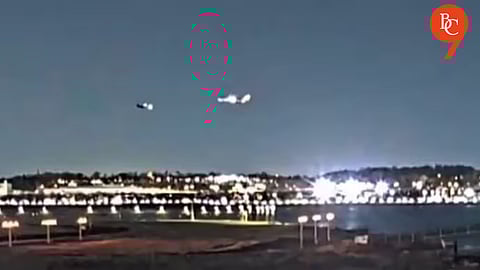


Newly released footage from one of the deadliest U.S. aviation accidents last year shows a mid-air collision between an American Airlines regional jet and a helicopter as they were landing at Reagan Washington National Airport.
The video broadcast by the TV program 60 Minutes shows the events around the crash at Reagan Washington National Airport, where an American Airlines regional jet and a US Army Black Hawk helicopter collided as the aircraft was coming in to land.
In all, 67 individuals lost their lives in the collision — 64 passengers and crew members aboard the American Airlines flight, along with three crew members on the helicopter.
Accident occurring during the landing approach
According to the Federal Aviation Administration (FAA), the collision occurred on the night of January 29, 2025, at approximately 9 p.m. Eastern Time. The plane, which had taken off from Wichita, Kansas, was approaching the runway when it collided mid-air with the helicopter.
Authorities later stated that the helicopter had been conducting a training exercise when the crash occurred.
Rescue teams rapidly entered the Potomac River where the debris had fallen. Initial recovery operations produced grim outcomes, with bodies retrieved and no survivors located, according to reports.
Firsthand reports and live on-site footage
An eyewitness reported seeing an aircraft with a bright yellow underside and sparks streaming from beneath it after the impact, comparing the scene to a massive firework in the sky.
Footage captured by nearby residents showed emergency teams operating over the river throughout the night, underscoring the magnitude and urgency of the rescue effort.
The cause of the crash is still being investigated. The National Transportation Safety Board (NTSB) is heading the inquiry, with assistance from the FAA.
Investigators are expected to review flight trajectories, communication logs, and other technical information to determine how the two aircraft collided within controlled airspace.
In response, American Airlines established support channels for the families of those on the flight. They provided a toll-free hotline for individuals requesting information about passengers, along with online assistance for callers outside the United States.
