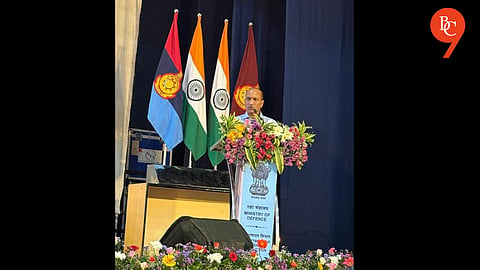

Pune: Accidents in the defence and explosives industry should not just be reduced but completely eliminated through the use of advanced technologies such as artificial intelligence (AI), smart sensors, CCTV surveillance, data analytics and automated control systems, Defence Secretary (Defence Production) Sanjeev Kumar said on Friday.
He was addressing the inaugural session of the first National Seminar on 'Military Explosives and Propellants: Safety and Compliance', organised by the Directorate General of Quality Assurance (DGQA) under the Ministry of Defence.
Senior officials from the Defence Ministry, DRDO, Petroleum and Explosives Safety Organisation (PESO), Centre for Fire, Explosive and Environment Safety (CFEES), the armed forces and representatives from public and private defence industries attended the event.
Kumar said India already has comprehensive safety standards and regulations for handling explosives, but accidents continue because of procedural lapses and human negligence.
"Our goal should not be to reduce accidents but to eliminate them completely. Strong safety regulations already exist, but human error continues to be the biggest challenge. AI, sensors, CCTV surveillance, data analytics and automated control systems must become mandatory across defence manufacturing to minimise human intervention and prevent avoidable accidents," Kumar said.
He added that while families of accident victims receive financial compensation, no amount of money can replace the emotional and psychological loss suffered by them. He stressed that there should be zero compromise on safety while handling high explosives and propellants.
Kumar said defence factories should adopt technology that continuously monitors machinery, raw materials, manufacturing processes and worker behaviour.
"Real-time monitoring through a centralised system can identify potential risks before they turn into accidents. Integrating AI-driven surveillance and early warning mechanisms into production facilities is essential for ensuring permanent improvements in industrial safety," he said.
DGQA Director General N. Manoharan said that despite advancements in technologies such as laser weapons and kinetic energy systems, explosives remain the primary means of destroying enemy targets in modern warfare.
"High-energy explosives and propellants demand the highest standards of safety. Strict compliance is required at every stage, from manufacturing and storage to transportation and disposal. With startups, MSMEs and private companies playing a growing role in defence production, maintaining robust safety practices has become more important than ever," Manoharan said.
Kumar also announced significant reforms aimed at encouraging private investment in defence manufacturing.
He said improved coordination between the Department of Defence Production (DDP) and the Department for Promotion of Industry and Internal Trade (DPIIT) has drastically simplified the industrial licensing process.
Earlier, companies had to obtain clearances from 19 different agencies before receiving licences. The process has now been streamlined to involve only three key authorities, reducing approval time from three to six months to less than one month. The reform is expected to accelerate the establishment of defence manufacturing facilities and speed up production across the sector.

