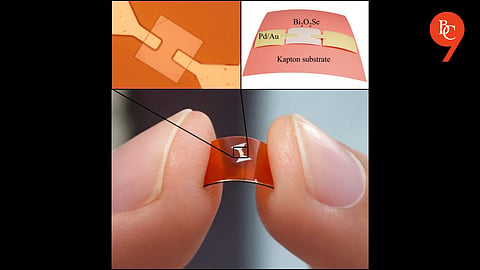

Pune, 20 February 2026: Scientists at the Indian Institute of Science Education and Research (IISER), Pune, have developed ultra-thin electronic devices using a special semiconductor material that can bend without losing performance.
The breakthrough brings India closer to developing flexible smartphones, foldable displays, smart clothing and wearable health monitors domestically.
The research team from IISER’s Department of Physics created nano-scale electronic devices using a two-dimensional semiconductor material called bismuth oxyselenide (Bi₂O₂Se). Their findings have been published in the international research journal Small.
As electronic devices become smaller and more powerful, conventional semiconductor materials are reaching their physical limits. Scientists worldwide are therefore exploring two-dimensional (2D) materials, which are only a few atoms thick and offer better speed, flexibility and efficiency.
The IISER team successfully developed large, stable and extremely thin bismuth oxyselenide nanosheets, a major challenge in the field until now. These nanosheets are thousands of times thinner than a sheet of A4 paper and significantly thinner than a human hair.
Using these nanosheets, the researchers built tiny electronic devices and mounted them on flexible plastic-like surfaces. The devices were repeatedly bent thousands of times during testing. Even after extensive bending, the devices showed no loss in performance or light sensitivity, proving their durability and reliability.
The breakthrough was achieved by precisely controlling temperature, gas flow, chemical composition and processing time during fabrication.
The research was led by Dr. Atikur Rahman, Associate Professor in the Department of Physics at IISER Pune. The team included Avinash Mahapatra, Sudipta Majumdar, Pawan Kumar Gupta, PhD scholar Srikrishna Bhagwat, postdoctoral researcher H. L. Pradeepa, Professor Shivprasad Patil and Dr. Rahman.
Speaking about the development, Dr. Rahman said, “To build truly flexible electronic devices, we need materials that are ultra-thin, fast, efficient and mechanically stable. Our bismuth oxyselenide nanosheets meet these requirements and can remain reliable even under continuous bending and stress. This technology will be crucial for future smartwatches, foldable displays and wearable medical sensors.”

