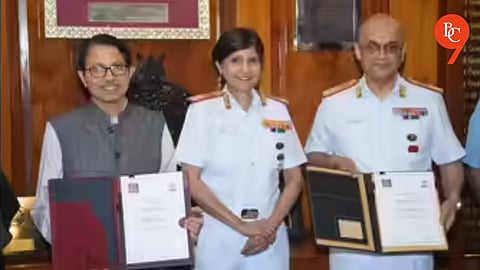

Pune, 6th February 2025: In a significant step towards improving battlefield healthcare, the Armed Forces Medical Services (AFMS) and the Indian Institute of Science (IISc) have come together to promote advanced research in combat medicine.
The collaboration aims to ensure that soldiers defending the nation’s borders receive timely and cutting-edge medical care in war-like conditions.
Under this historic memorandum of understanding, the two institutions will work jointly on developing next-generation medical technologies using artificial intelligence and wearable devices. The focus will be on faster diagnosis, emergency treatment on the battlefield, effective surgeries, and improved rehabilitation for injured soldiers.
Explaining the vision behind the partnership, Prof. Dr. Navakant Bhat, Dean of the Interdisciplinary Sciences Department at IISc, said the goal is to translate laboratory research into real-world medical solutions. He noted that AFMS brings strong clinical expertise, while IISc contributes its legacy in science and technology, creating a powerful platform for innovation.
The collaboration will include joint research projects, technology development aligned with defence needs, PhD programmes, workshops, conferences, and shared academic courses.
Prof. Bhat also clarified that the MoU is not just a formal agreement on paper. He said that collaborative research had already begun even before the signing, with an AFMS researcher currently pursuing a PhD in IISc’s bioengineering department, and several other research themes already identified.
A major thrust of the partnership is to give momentum to the field of combat medicine, similar to the way space medicine has evolved. Scientists and doctors will work together to address real challenges faced on the battlefield, such as rapid treatment of war injuries, faster wound healing, emergency surgeries, and post-surgical recovery.
The idea is to first understand ground-level problems faced by soldiers and then design technical solutions around them.
Another important objective is to nurture a new generation of “physician scientists.” Through this initiative, doctors will not only treat patients but also actively participate in developing medical devices and technologies. AFMS clinicians will conduct research at IISc to find solutions to practical medical challenges, helping build a strong ecosystem of doctor-researchers in India.
IISc’s earlier contribution to space medicine provides a strong foundation for this effort. As part of India’s Gaganyaan mission, all four selected astronauts completed a two-year MTech by Research programme at IISc, studying the effects of space and zero gravity on the human body. Drawing from this experience, similar scientific approaches will now be applied to address the physical challenges faced by soldiers.
The outcomes of this collaboration are expected to benefit not only the armed forces but also civilian healthcare, as innovations developed for extreme conditions often find wider applications in public health and emergency medicine.

