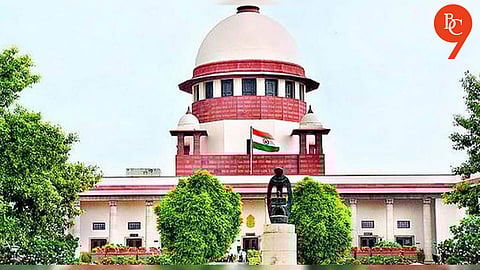


On Thursday, the Supreme Court issued a strong rebuke to political parties nationwide for their role in distributing and encouraging the 'freebie culture,' stating that it obstructs economic progress and noting that it is crucial to reassess these policies.
Acknowledging a request from the DMK government-led Tamil Nadu Power Distribution Corporation Ltd, which suggested providing free electricity to all citizens irrespective of their economic condition, the highest court remarked that it is reasonable for states to decide to aid the underprivileged.
Supreme Court's remarks on the 'culture of freebies'
The highest court suggested that rather than distributing resources via these schemes, political parties should implement well-thought-out policies aimed at enhancing people's lives, like unemployment programs.
A bench comprising Chief Justice Surya Kant and Justices Joymalya Bagchi and Vipul M Pancholi noted that although most states in the country are experiencing revenue deficits, they continue to provide freebies while neglecting development.
Chief Justice of India Surya Kant noted that the country's economic development might be obstructed by such liberal distribution. Although it is certainly the state's duty to offer support, shouldn't there be an examination of those who are receiving these handouts?
He mentioned, "States are facing budget deficits yet continue to offer freebies. Consider this: why can't 25 percent of the annual revenue be allocated for the state's development?"
The highest court stated that the matter was not limited to a single state but affected all states across the nation.
“Justice Joymalya Bagchi remarked that the discussion is not limited to a single state but concerns all states. He emphasized that it involves planned spending and questioned why budget proposals are not being made with justifications, stating, 'This is my allocation for addressing unemployment.'
‘What type of culture are we fostering?': Supreme Court criticizes
The highest court reprimanded the Tamil Nadu company for unexpectedly deciding to spend more money following the announcement of the electricity tariff.
The bench stated that rather than investing in development projects, states are focusing on two activities: paying salaries and handing out benefits.
What type of culture are we fostering in India? The bench questioned, noting that while it is understandable to offer support to those unable to pay electricity bills as a welfare measure.
The CJI questioned whether distributing without differentiating between those who can afford it and those who cannot would result in a policy of appeasement.
