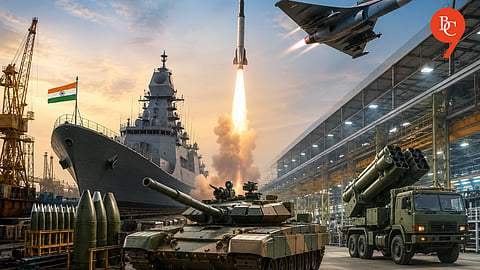

Pune, 1st August 2026: India's defence production has touched ₹1.76 lakh crore, with the private sector now accounting for nearly 25% of the total output, reflecting the growing impact of the Atmanirbhar Bharat initiative.
The expansion has encouraged greater participation from private companies, startups and MSMEs in defence manufacturing, particularly in the explosives and ammunition sector.
Speaking to reporters after a national seminar organised by the Directorate General of Quality Assurance (DGQA) in Pune, Defence Production Secretary Sanjeev Kumar and DGQA Director General N. Manoharan said that more than 150 companies are currently undergoing the licensing process to manufacture explosives and propellants in India.
Officials said the government's push for self-reliance has significantly increased private investment in defence production. Alongside established manufacturers, startups and MSMEs are playing an increasingly important role in supplying critical defence equipment and ammunition.
They added that the rising number of companies seeking manufacturing licences reflects growing confidence in India's defence production ecosystem.
Responding to questions about accidents at explosive manufacturing units in places such as Nagpur and Bhandara, Sanjeev Kumar said there are no separate safety norms for government and private defence manufacturers.
He explained that all factories must comply with the same safety guidelines issued by CFEEES and PESO. Following past accidents in government ordnance factories, the Defence Production Department has introduced additional safety improvement measures and continues to monitor their implementation while encouraging the adoption of advanced technologies to make production safer and more efficient.

DGQA Director General N. Manoharan said companies entering the explosives and ammunition sector have several options to acquire technology. They can receive technical guidance from DRDO's High Energy Materials Research Laboratory (HEMRL) in Pune, collaborate with existing Indian manufacturers, or obtain technology through transfers from foreign companies.
He also noted that whenever ammunition-related accidents occur during military training or testing, a dedicated fault investigation process is initiated.
Experts scientifically examine recovered ammunition fragments and samples from the same production batch to determine whether the problem lies in the explosive material or the manufacturing process. Based on the findings, manufacturers are advised to make necessary improvements.
Sanjeev Kumar said Pune was chosen to host the national seminar because it has become one of India's most important centres for defence and explosives manufacturing.
The city is home to DRDO's HEMRL, the Controller of Military Explosives under DGQA, and a large concentration of defence industries, making it a strategic hub for the country's expanding defence production sector.
